

 -0.15 (-0.85%)
 Tornar
 As architects, hydraulic engineers and commercial facility operators seek more efficient and swimmer-friendly solutions, ozone in swimming pools has established itself as one of the most robust technical alternatives to conventional chlorine.
Although it has been used in water treatment for over a century, ozone is gaining ground in hotels, sports centres, spas and wellness projects due to its greater oxidising capacity, lower generation of by-products and a water quality that is noticeable on the skin, in the eyes and in the overall perception of the facility.
In this article, we analyse how water treatment with ozone works in swimming pools, what advantages it offers, in which projects it makes the most sense, and what technical considerations should be borne in mind from the design stage onwards.


 Contacte
 Tancar
What is ozone and what role does it play in water treatment?
Ozone (O₃) is an allotropic form of oxygen composed of three atoms and one of the most powerful oxidants used in water treatment. In the context of swimming pools, it is used to oxidise organic matter, inactivate microorganisms and improve water quality without leaving persistent chemical residues.
Unlike traditional disinfectants, ozone is neither stored nor transported: it is generated on-site, within the pool’s technical room, and injected into the hydraulic circuit before the water returns to the pool. This characteristic sets it apart from chlorine or bromine and influences both its installation and its integration with other systems.
Its use is not new. It has been used since the late 19th century in the treatment of drinking water and has been applied for decades in European commercial swimming pools, particularly in environments where water quality is a critical factor.
How does ozone disinfection work in swimming pools?
Ozone disinfection in swimming pools involves generating ozone from oxygen in the air, introducing it into the water within a contact chamber, and removing the residual ozone before the water returns to the pool. Ozone acts within seconds and breaks down rapidly, leaving no residual concentration in the pool.
The process usually follows these steps:
- Ozone generation. This is produced by corona discharge (a high-voltage electric field that dissociates O₂) or UV lamps. Corona discharge is the most common method in large installations due to its higher efficiency.
- Injection and mixing. The ozone is introduced into the filtration circuit via a venturi, ensuring a homogeneous mixture with the water.
- Contact chamber. The ozonated water remains for a few minutes in a tank where the ozone reacts with contaminants, microorganisms and organic matter.
- Degassing. Residual ozone is removed before the water is returned to the pool.
- Supplementary dosing. As ozone leaves no residual, a secondary disinfectant (usually low-dose chlorine) is added to maintain water quality between cycles.
This cyclical operation explains why ozone does not completely replace chlorine, but acts as the primary oxidant, relegating chlorine to a much lesser residual role.
What are the advantages of ozone over traditional chlorine?
The main advantage of ozone for swimming pools is its oxidising power: it is between 3 and 4 times more potent than chlorine and acts much faster against bacteria, viruses, fungi and organic matter. The result is cleaner water, with fewer by-products and a more pleasant swimming experience.
The most significant advantages are:
- Fewer chloramines. By oxidising organic matter before it reacts with residual chlorine, the formation of chloramines—which are responsible for the ‘swimming pool’ smell and for eye and respiratory irritation—is reduced. This is a critical factor in indoor swimming pools, where air quality depends on water chemistry.
- Clearer water. Ozone improves flocculation and the removal of fine particles, resulting in water that is visually clearer.
- Lower chemical consumption. The amount of chlorine required is reduced, leading to operational savings and a lower environmental impact.
- Greater comfort for bathers. Less irritation, less odour, and less damage to skin and hair. A key factor in hotels, spas and wellness centres.
On the other hand, ozone requires a higher initial investment than a conventional chlorination system and demands a more careful technical design, something that should be planned from the project phase onwards.
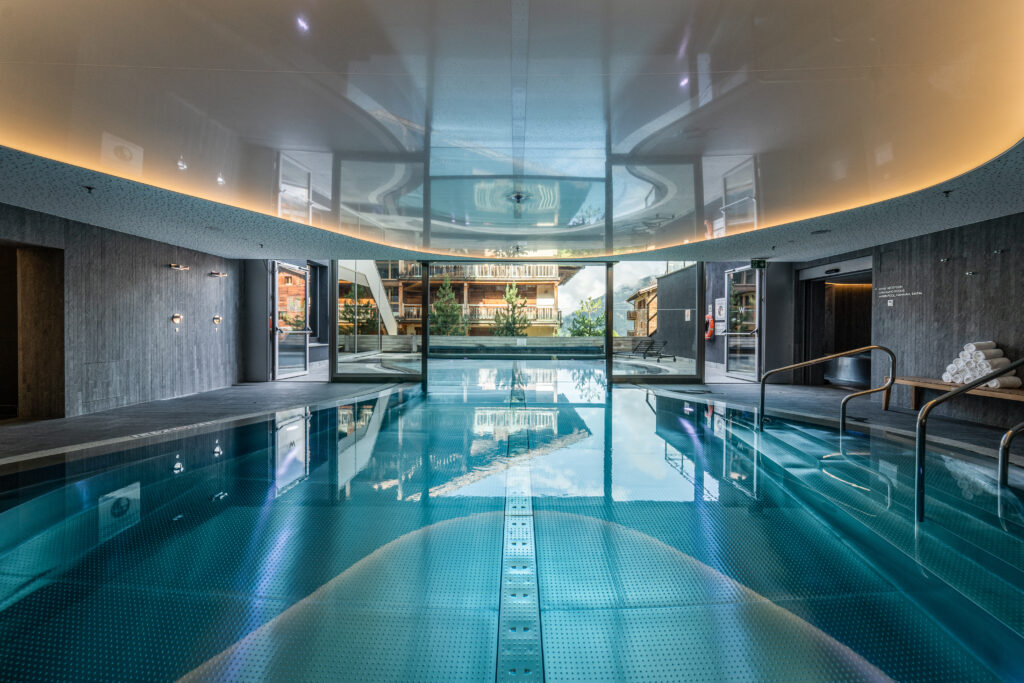
In what types of facilities is ozone most recommended for swimming pools?
Water treatment with ozone is particularly beneficial in facilities where water quality, the user experience or the volume of bathers mean that conventional systems fall short. Commercial, wellness and sports swimming pools are the contexts where it offers the greatest added value.
The most common use cases are:
- Hotels and resorts. The perception of water quality directly influences guest satisfaction. Less chlorine smell and less irritation are key factors in a premium experience.
- Spas and wellness centres. Water circuits, which include vitality pools, hydromassage and contrast zones, require impeccable water.
- Sports and competition pools. The reduction of chloramines improves air quality in indoor facilities, a critical factor for athletes who spend hours in the water.
- Water parks and municipal swimming pools. High visitor numbers and large volumes mean that ozone’s oxidising efficacy more than justifies the higher initial investment.
- High-end residential projects that prioritise water quality and integration with automated systems.
In each of these environments, ozone rarely works alone: it is integrated with other treatment systems to deliver optimal results.
How does ozone integrate with other water treatment systems?
Ozone in swimming pools is typically used in combination with other systems, as its lack of residual effect makes a secondary disinfectant essential. This integration allows for the design of multi-barrier treatment strategies that are more efficient than any individual system.
The most common combinations are:
- Ozone + residual chlorine. The classic approach: ozone acts as the primary oxidant and chlorine, in minimal doses, maintains the residual level in the tank.
- Advanced oxidation processes (AOP). These combine ozone with UV or hydrogen peroxide to generate hydroxyl radicals, which are even more reactive. They are particularly effective against persistent contaminants.
- Hybrid systems with salt electrolysis. Fluidra’s Neolysis technology combines low-salinity electrolysis and ultraviolet light for advanced disinfection with reduced reliance on chemicals.
- Automation and monitoring. Platforms such as Fluidra Connect or Datapool monitor water parameters (pH, ORP, flow rate, consumption) in real time and adjust ozone dosing predictively.
This integrated approach is the most efficient way to ensure consistent water quality, reduce manual errors and optimise resources.
What technical considerations are involved in installing an ozone system in swimming pools?
The installation of an ozone system in swimming pools requires careful design right from the planning stage. Ozone is a toxic gas at high concentrations, so sizing, compatible materials and safety measures are crucial.
The key technical aspects are:
- Sizing. The generator’s capacity must be calculated based on the water volume, recirculation frequency and number of bathers.
- Space in the plant room. The equipment requires additional space for the generator, contact chamber and degassing unit. This should be taken into account from the design stage, particularly in refurbishment projects.
- Compatible materials. Pipes, joints and components in contact with the gas or ozonated water must be made of AISI 316 stainless steel, PVDF, PTFE or specific elastomers.
- Safety and ventilation. The plant room must be equipped with leak detectors, adequate ventilation and catalytic scrubbers.
- Maintenance. Generators require regular servicing (cleaning of electrodes and filters, calibration of sensors) as part of a preventative maintenance plan.
Planning these aspects from the design stage avoids cost overruns and bottlenecks during construction. For this reason, methodologies such as BIM-based projects are particularly useful in installations where ozone treatment forms part of the system.
How does ozone contribute to a more sustainable and efficient swimming pool?
Beyond water quality, ozone for swimming pools has a direct impact on sustainability and operational efficiency. It is one of the most interesting elements for operators wishing to move towards the concept of a ‘positive pool’: a pool that reduces its environmental footprint and optimises every resource.
The most significant benefits are:
- Lower chemical consumption, and therefore less transport, storage and handling of hazardous products.
- Fewer disinfection by-products. Ozone does not generate trihalomethanes or other halogenated compounds associated with chlorine.
- More efficient filtration. The oxidising action facilitates the flocculation of fine particles. Combined with regenerative filters, it contributes to water conservation by reducing backwash consumption.
- Reduced need for water renewal. More stable water quality allows renewal cycles to be spaced out, saving water and energy.
- Smart management. Connected to systems such as Datapool or Fluidra Connect, ozone is dosed in real time to match actual demand.
This approach makes ozone a strategic ally for operational efficiency and water management aligned with current sustainability criteria.
Ozone in swimming pools as a key component of modern water treatment
Ozone in swimming pools is much more than an alternative to chlorine: it is a mature, powerful technology that integrates seamlessly into modern water treatment, particularly in commercial, sports and wellness facilities.
Its advantages in terms of water quality, swimmer comfort, operational efficiency and sustainability make it an increasingly relevant option for architects, engineers and managers seeking to differentiate their projects and optimise their long-term operation.
Proper design, integration with other systems and smart management are the keys to unlocking its full potential. Having a technical partner like Fluidra, with solutions such as Neolysis, Fluidra Connect and Datapool, allows each project to be approached from a holistic perspective that places water quality and sustainability at the centre.
Frequently asked questions about ozone in swimming pools
Is ozone safe for swimmers?
Yes, provided the installation is correctly designed. Ozone acts in a contact chamber outside the pool and is removed by degassing before the water returns to the swimmers. The residual concentration in the pool is practically zero, and the plant rooms incorporate leak sensors and catalytic destroyers.
Does ozone completely replace chlorine?
In most installations, no. Ozone acts as the primary oxidant but leaves no residual in the pool, so it is combined with a low dose of chlorine or another disinfectant. This combination allows for a significant reduction in chlorine consumption compared to a traditional system.
How much does it cost to install an ozone system in a swimming pool?
The investment depends on the size of the pool, the type of generator and the additional components. It is more expensive than a conventional chlorination system, but the savings on chemicals, lower maintenance costs and improved water quality offset the investment in the medium term, particularly in high-use commercial pools.
What is the difference between ozone and UV in water treatment?
Ozone is an oxidant that removes organic matter and disinfects at the same time; UV only disinfects without oxidising chemical contaminants. For this reason, many facilities combine both in advanced oxidation processes (AOP), which generate hydroxyl radicals with even greater oxidising power.
Is ozone compatible with salt electrolysis?
Yes. Solutions such as Neolysis combine low-concentration salt electrolysis with UV to provide advanced disinfection. Ozone can also be integrated with salt electrolysis in facilities seeking a multi-barrier strategy.