

 0.04 (+0.23%)
 Tornar
  Contacte
 Tancar
If you find that your pool water is white, milky, or cloudy, it usually indicates that there are suspended particles or that some aspect of the water treatment system isn’t working properly. The cause could be a chemical imbalance, poor filtration, or a temporary increase in contaminants.
Therefore, if you’re wondering why your pool water is white, you shouldn’t start adding chemicals without first identifying the cause. Checking the water parameters and the system’s operation allows you to address the actual problem and restore clarity more effectively.
Causes of Cloudy Pool Water
The whitish appearance occurs when small particles remain suspended in the water and cannot be properly removed. Although the result may look similar at first glance, there can be different causes.
Chemical imbalance (pH, alkalinity, chlorine)
The first thing to check is the water’s chemical balance. A pH that is too high can reduce the effectiveness of disinfection and promote mineral precipitation, especially when the water has high hardness.
Properly maintaining the water’s pH level is essential for the pool’s treatment system to function properly and to prevent changes that could affect its clarity.
It is also important to monitor alkalinity. This parameter is directly related to pH stability: when it is too high, it can make pH regulation difficult and promote certain conditions that ultimately lead to cloudy water. In these cases, knowing how to reduce the pool’s alkalinity allows you to address the problem at its source rather than merely treating the water’s appearance.
The disinfectant level must also be maintained within the appropriate range for each pool. If it is insufficient, organic matter and microorganisms can accumulate and contribute to a gradual loss of clarity.
Insufficient Filtration or a Clogged Filter
The water chemistry may be properly balanced, yet the water may still be cloudy. In that case, the filtration system needs to be checked.
The pump circulates the water while the filter traps the particles and contaminants present in it. When the filter is saturated, dirty, damaged, or operating at an inadequate flow rate, some of these particles remain in suspension and progressively reduce clarity.
This can also occur when the operating time is insufficient for the pool’s actual conditions. There is no single number of hours that applies to all installations: the water volume, temperature, number of swimmers, and the characteristics of the system itself determine the circulation and filtration requirements.
If you’re experiencing a recurring problem with cloudy water, you should also check the condition of the pre-filters and skimmers, as well as the filter pressure and circulation flow rate.
Excessive number of swimmers or organic contamination
In heavily used pools, especially commercial facilities, water quality can change rapidly.
Each swimmer introduces small amounts of organic matter from sweat, cosmetics, sunscreen, or particles adhering to the body. Added to this can be dust, pollen, leaves, and other debris from the surrounding environment.
When this load temporarily exceeds the capacity of the treatment and filtration system, the amount of suspended particles increases, and the water may take on a cloudy or whitish appearance.
For this reason, a pool may have good water quality under normal conditions but lose its clarity after a day of particularly heavy use.
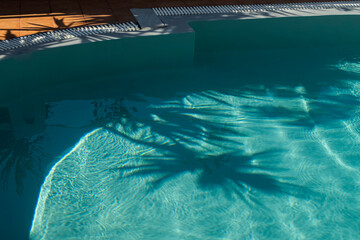
What to Do When the Water Is White: A Step-by-Step Solution
If you’re wondering what to do when your pool water is white, the most important thing is to follow a systematic approach and avoid making random adjustments.
1. Analyze the water parameters. Check the pH, disinfectant level, and alkalinity. Depending on the pool’s characteristics, it may also be necessary to check other parameters, such as water hardness.
2. Correct the abnormal values. Adjust only those parameters that are outside the appropriate ranges. Adding chemicals without first taking a reading can worsen the imbalance rather than fix it.
3. Check the filtration system. Verify that the pump, filter, pre-filters, skimmers, and return lines are functioning properly. If the filter is clogged, perform the necessary cleaning or maintenance.
4. Remove accumulated debris. Clean the bottom, walls, surface, and waterline to prevent debris from continuing to enter the water.
5. Facilitate the removal of fine particles if necessary. In certain situations, the particles causing turbidity are too small to be easily trapped by the filter. Clarification or flocculation systems appropriate for the installation can help aggregate them and facilitate their removal.
6. Check the water quality again. Once corrections have been made, remeasure the parameters and verify that the water is gradually regaining its clarity.
How to Prevent Cloudy Water in Commercial Facilities
In commercial pools, preventing turbidity is especially important because conditions can change rapidly depending on occupancy and facility usage.
The most effective strategy is to combine regular monitoring of parameters, cleaning, and properly sized and maintained filtration. Recording measurements also helps detect deviations before they lead to a visible problem.
In addition, the facility’s operation must be adapted to actual usage conditions. A day with a high volume of swimmers generates a very different load than a period of low occupancy, so treatment and filtration must be able to respond to these variations.
In short, whitish water in a pool is not merely an aesthetic issue, but a sign that the balance between treatment, circulation, filtration, and usage conditions should be reviewed. In commercial facilities, proper water management and correctly sized systems make it possible to anticipate these issues.