

 0.04 (+0.2%)
 Go back
 The best salt chlorinator isn’t the most expensive one, but the one that’s suited to your pool’s volume, filtration hours, and the level of automation you need. Choosing the right one improves disinfection, reduces maintenance, and extends the equipment’s lifespan.


 Contact us
 Close form
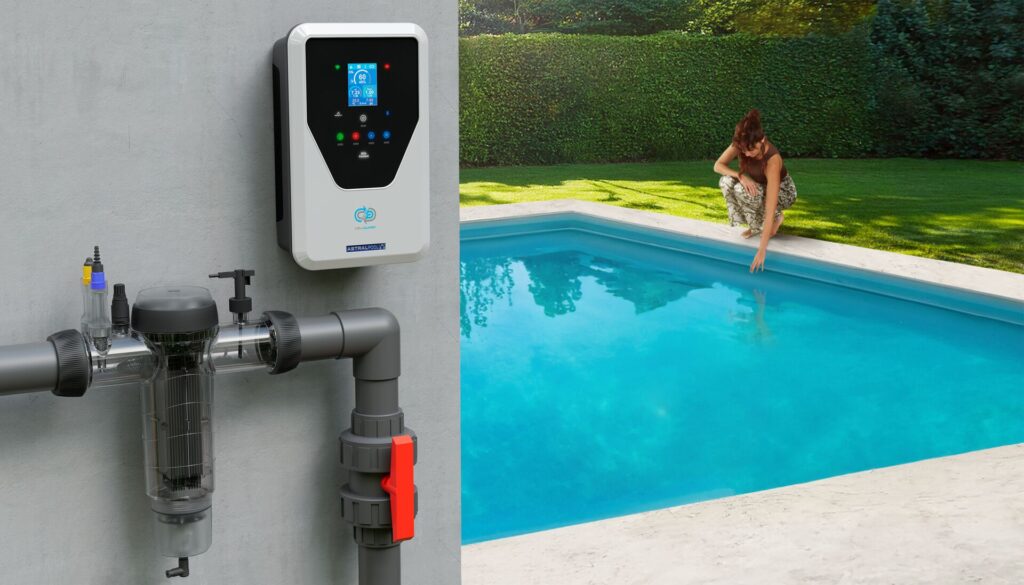
Saltwater electrolysis is now the most widely used disinfection system in new pools: it continuously generates chlorine from salt dissolved in the water, eliminates the need to handle solid or liquid chemicals, and, when properly sized, keeps the water balanced with minimal maintenance.
When looking for the best salt chlorinators, you don’t need a list of models without context. You need to know what parameters define a good unit, which brands have a proven track record, and how to identify the best value-for-money salt chlorinator for your specific installation.
That is why, in a saltwater pool, this system has become one of the most highly valued solutions for swimming comfort, water stability, and ease of use
How a salt chlorinator works: the principle that changes everything
The salt chlorinator does not add chlorine to the water: it produces it within the filtration circuit itself. The process is called electrolysis: when water containing salt (sodium chloride, NaCl) passes through the electrolytic cell, a low-voltage electric current breaks down the salt into active chlorine (sodium hypochlorite) and caustic soda. The chlorine disinfects the water and, as it is consumed, reverts to salt, continuously closing the cycle.
The practical benefits of this mechanism are significant:
- The water feels softer and is less harsh on the skin, hair, and swimwear than traditional chlorination with tablets.
- There is no need to store or handle chlorine at home, which reduces risks and simplifies daily maintenance.
- The long-term operating cost is lower, although the initial outlay is slightly higher than that of a conventional dosing system.
- It requires pH adjustment and monitoring, as electrolysis tends to raise the pH slightly. Without proper control, the chlorine loses its effectiveness.
What Makes a Salt Chlorinator Truly Good
Not all salt chlorinators are created equal. Beyond price, there are technical factors that determine whether a unit will perform well for years or cause problems and unexpected costs.
- Chlorine production (g/h): Chlorine production in grams per hour determines whether the unit can disinfect your pool’s water volume during daily filtration hours. An undersized unit will never maintain the necessary free chlorine level, especially in summer with high temperatures and heavy use.
- Service life of the electrolytic cell: The cell is the component that wears out. Titanium electrodes coated with precious metal oxides (ruthenium, iridium) have a finite service life, measured in hours of operation. Reputable manufacturers specify this: a typical range for quality units is between 8,000 and 15,000 hours of operation. The AstralPool Easy Salt Next VC exceeds 12,000 hours with its Premium+ electrode.
- Self-cleaning via polarity reversal: Calcium in the water deposits on the electrodes and reduces the cell’s efficiency. The best salt chlorinators automatically reverse the polarity of the electrodes at regular intervals, dislodging deposits without manual intervention. In hard water areas, this feature goes from being convenient to being essential.
- Integrated or compatible pH control: pH is the parameter that most affects chlorine effectiveness. At pH 8 or higher, more than 80% of free chlorine is in the form of hypochlorite, which has virtually no disinfecting power. The AstralPool Pro-Chlore Salt Plus incorporates automatic ORP and pH control and regulation, automating this adjustment without manual intervention. Without proper control, chlorine loses its effectiveness and imbalances can arise, leading to problems such as green water in pools.
- Salt concentration in the water: Most residential chlorinators operate within a range of 3 to 5 g/L. Some new-generation models operate at much lower concentrations: AstralPool’s Nature Salt Plus works with as little as 2 g/L, which reduces perceptible salinity, corrosion of metal components, and environmental impact.
Comparison of salt chlorinators: leading brands on the market
Below is a comparison of the brands with the strongest presence and track record in the European and Spanish markets, highlighting the most relevant aspects for making an informed decision.
| Model / Range | Use / Max. Vol. | Self-cleaning | Approx. price | Profile and highlights |
|---|---|---|---|---|
| Easy Salt / Easy Salt Next VC | Up to 100 m³ | Yes | Medium-high | Premium+ electrode, >12,000 hours, HMI touchscreen, Fluidra Connect |
| Pro-Chlore Salt / Pro-Chlore Salt Plus | Public pools | Yes (EX) | High | 50–600 g/h; Plus version with integrated ORP and pH control |
| Nature Salt Plus | Sustainable public use | Yes (EX-LS) | High | Only 2 g/L salt; TWINCELL SYSTEM; removes chloramines without chemicals |
| Neolysis S & LS + UV | Premium public | Yes + UV | High | Electrolysis + UV; reduces chemicals by up to 90% |
| AquaRite / TurboCell | Up to 114 m³ | Yes | Medium-high | Widely used in the U.S. and Europe; integrates with automation |
| IntelliChlor IC40 / IC60 | Up to 150 m³ | Yes | High | High precision; ideal for large pools with advanced automation |
| AquaPure / TRi | Up to 120 m³ | Yes | Medium-high | Good connectivity with home automation systems |
| Krystal Clear (QS) | Up to 26 m³ | No | Low | Affordable solution for above-ground pools; quality matches the price |
Best value-for-money salt chlorinator: how to evaluate without being swayed by price
The search for the best value-for-money salt chlorinator is, in reality, a question of how much the system costs over its entire lifespan, not just at the time of purchase. A cheap unit that requires replacing the cell every two years may end up being more expensive over a five-year period than a mid-range model with a long-lasting cell.
| Criteria | Importance | What to look for | Common mistake |
|---|---|---|---|
| Chlorine production (g/h) | High | It should cover the volume with a margin of 20–30% | Choosing based on price without checking if the output is sufficient |
| Electrode lifespan | High | Reputable manufacturers specify service life (8,000–15,000 hours; Easy Salt Next VC exceeds 12,000 hours) | Buying brands without a stated cell lifespan |
| Cell self-cleaning | Medium-high | Automatic polarity reversal; reduces manual maintenance | Assume that all models include this feature (entry-level models do not) |
| Integrated pH control | Medium | Very useful if you want to automate; makes the equipment more expensive | Paying for pH control without a dosing system |
| Low salt concentration | Medium | Low-salt models (e.g., Nature Salt Plus, 2 g/L) reduce corrosiveness and noticeable salinity | Ignore this parameter in pools with metal components |
| Connectivity / App | Low-medium | Convenient but not essential; consider whether you’ll actually use it | If you’re not going to use the app, you’re paying an unnecessary extra |
How to size your salt chlorinator: output, volume, and filtration hours
Choosing the brand is only half the job. Sizing the equipment correctly is just as important. An undersized chlorinator cannot maintain the necessary free chlorine level; an oversized one wastes energy and can lead to excessive chlorine concentrations.
| Pool volume | Recommended output | Approx. initial salt | Note |
|---|---|---|---|
| Up to 25 m³ | 4–6 g/h | ~3–4 kg NaCl | Large above-ground or small in-ground pools |
| 25–50 m³ | 8–12 g/h | ~6–9 kg NaCl | Standard residential pools |
| 50–80 m³ | 14–20 g/h | ~9–14 kg NaCl | Large, frequently used pools |
| 80–120 m³ | 22–30 g/h | ~14–20 kg NaCl | Heavy-use or semi-public pools |
| Over 120 m³ | +30 g/h | Consult | Commercial facilities; requires specific design |
Factors that increase chlorine demand
- Chlorine is consumed more quickly. In heated pools or in areas with very hot summers, add 20–30% to the theoretical production rate.
- Organic matter, sunscreen, and sweat significantly increase chlorine demand. Intensive use or a large number of swimmers.
- Free chlorine is degraded by UV radiation. In uncovered pools with many hours of sunlight, consumption increases.
- It does not directly affect chlorine, but it shortens the cell’s lifespan if there is no self-cleaning and if the pH is not well controlled.
Salt concentration: startup and maintenance
Most systems operate between 3 and 5 g/L, although low-salt models like the Nature Salt Plus operate at 2 g/L. To calculate the initial salt required:
Salt (kg) = Volume (m³) × target concentration (g/L) ÷ 1000
Once the system is up and running, you only need to replenish the salt lost through filter backwash, splashing, and periodic purges. Under normal conditions, annual replenishment is minimal.