

 -0.03 (-0.17%)
 Go back
 The removal of small particles represents a challenge for most pool filtration systems. Flocculation and coagulation in water treatment turn out to be a solution to this issue.
Flocculation and coagulation in water treatment stand at the heart of every successful pool cleaning process today. Every pool operator knows that achieving total water transparency is key for their business success.
But fully clean and hygienic pools not only attract and retain swimming pool clients: they also drive down maintenance costs and may extend equipment life cycles.
In a nutshell, flocculation and coagulation in water treatment work together to eliminate small particles in pool water. Keep reading to find out how they do so, and the best options in the current market to guarantee water clarity.


 Contact us
 Close form
Cloudy water in a pool doesn’t always mean it’s “dirty” at first glance. Sometimes, the problem lies in particles so small that the filter cannot trap them: dust, organic matter, sunscreen residue, pollen, or suspended impurities. This is where pool flocculation comes into play—a process that helps clump these microscopic particles together so they can be removed more easily.
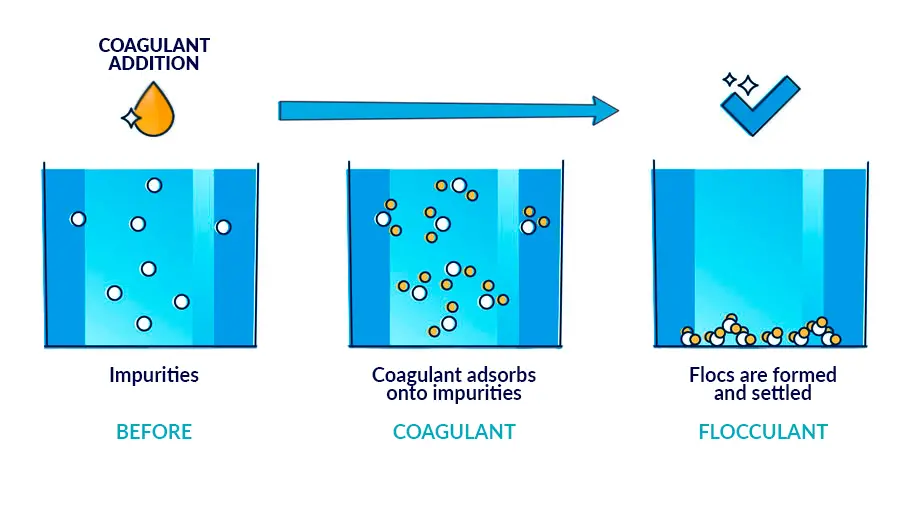
The flocculant acts like a “magnet” that binds these impurities together, forming larger particles called flocs. As they grow in size, they sink to the bottom of the pool or are more effectively trapped by the filtration system. So, when someone asks what pool flocculation is or what a pool flocculant is, the simple answer is: it’s a supplementary treatment to restore water clarity when regular filtration isn’t enough.
What effect does flocculant have on the water?
The main effect of flocculant in a pool is to improve water clarity. It does not disinfect, it does not replace chlorine, and it does not correct a chemical imbalance on its own, but it does help remove particles that cause a whitish, milky, or cloudy appearance.
It’s important to understand this clearly: a pool can have cloudy water even if the basic parameters seem correct. In such cases, flocculant can be helpful because it allows fine debris to settle or be captured by the filter.
Before applying it, it is advisable to check the pool’s pH and chlorine levels, as poorly balanced water can reduce the treatment’s effectiveness and cause the problem to reappear.
When to use flocculant in the pool
The use of flocculant in the pool is recommended when the water loses its clarity and normal filtration fails to restore it. This can occur after a storm, following heavy use by swimmers, due to dust or pollen entering the water, from dead algae after a shock treatment, or from an accumulation of very fine particles.
It should not be used as an automatic solution for every problem. If the water is green, smells bad, or has unbalanced chemical levels, you must first address the root cause: disinfection, pH, alkalinity, filtration, or pool cleaning. Flocculant is an aid for clarification, not a substitute for maintenance.
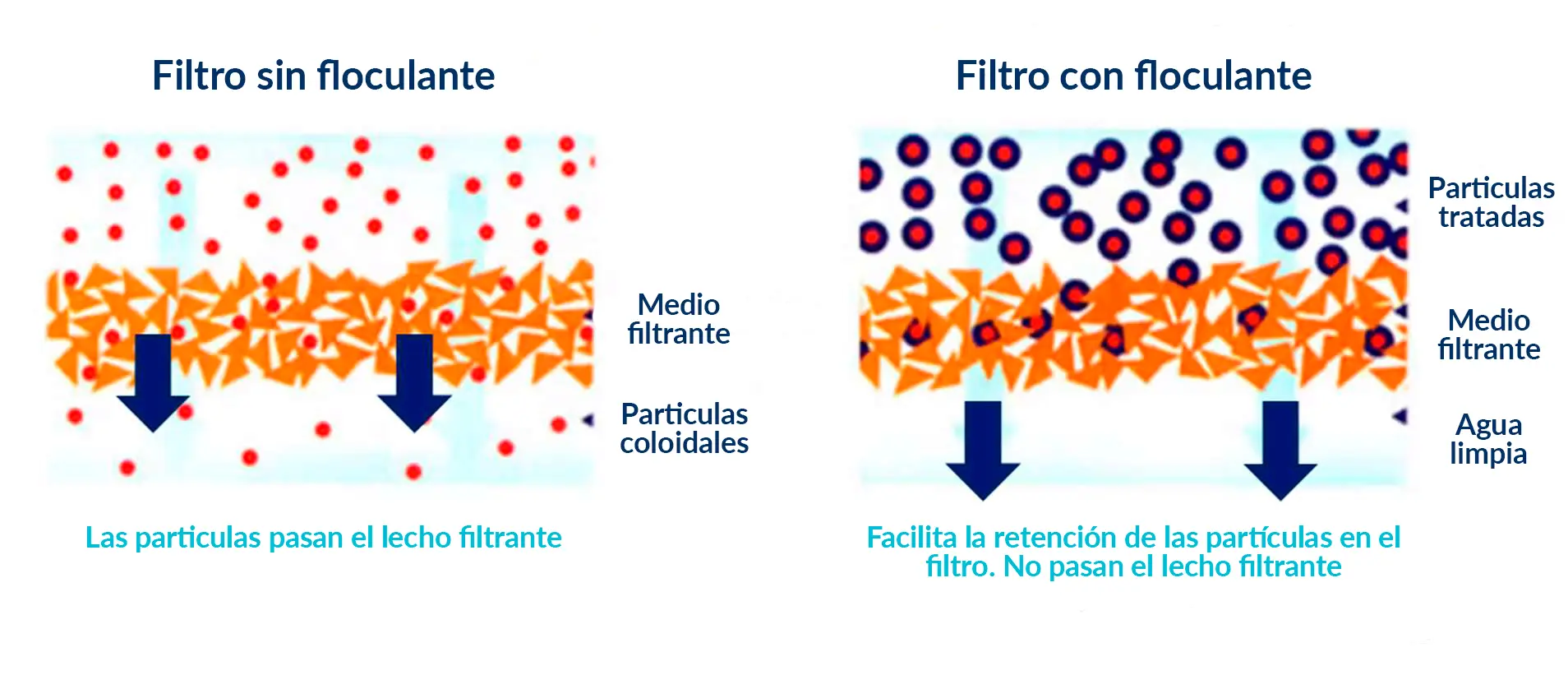
You must also be careful with filtration systems. Some liquid flocculants are designed so that particles sink to the bottom and are then sucked directly into the drain, not to pass through the filter. That is why it is always best to follow the manufacturer’s instructions.
How to Use Flocculant in a Pool, Step by Step
To apply flocculant correctly, it is best to follow a systematic process:
- Test the water. Check the pH and add disinfectant. As a general rule, the pH should be within the proper range before applying any product.
- Remove leaves and large debris. Flocculant works on small particles; it does not replace manual cleaning.
- Add the product according to the recommended dosage. It may come in liquid, tablet, or cartridge form, depending on the type of treatment.
- Distribute the product. For liquid flocculants, it is usually applied around the perimeter of the pool while the filtration system is running for a short time.
- Let it sit. Many treatments require several hours of rest so that the flocs settle to the bottom.
- Vacuum slowly. If the debris has settled to the bottom, vacuum it up carefully, preferably toward the drain if the manufacturer recommends it.
- Check the water again. Adjust the parameters and maintain proper filtration.
This process restores clarity without overdosing or unnecessarily straining the filtration system.
How much flocculant to add based on water volume
One of the most common questions is how much pool flocculant to add. The answer depends on the product’s form, concentration, the condition of the water, and the pool’s volume. As a guideline found in industry reference materials, some liquid flocculants recommend between 5 and 10 ml per cubic meter of water, though this figure may vary by manufacturer.
For example, for a 50 m³ pool, that would be roughly 250 to 500 ml of product. Still, the safest rule is not to wing it: always read the label and avoid thinking that “more product” will yield better results. Using too much can create residue, clog the filter, or temporarily make the water look worse.
If you have questions about which treatment best suits the condition of your pool, this guide to the best pool treatments can also help.
Coagulation and Flocculation in Water Treatment: Differences
Coagulation and flocculation in water treatment are related processes, but they are not identical. Coagulation is typically the phase in which the electrical charges of very small particles are neutralized so they stop repelling each other. Flocculation, on the other hand, helps these already destabilized particles clump together into larger flocs that are easier to remove.
In a residential or commercial pool, both concepts help explain why the water becomes clear: it’s not enough to “kill” microorganisms; you also have to physically remove the impurities that remain in suspension.
In short, flocculation is a very useful tool when the water is cloudy and filtration fails to remove the finest particles. When applied correctly, it improves clarity and simplifies maintenance. And if you’re looking for a more efficient, healthy, and easy-to-manage pool, having professional solutions for water treatment, filtration, and control can make all the difference in the daily swimming experience and the quality perceived by users.