

 0.1 (+0.56%)
 Go back
 Selecting the right pool heater can make a huge difference in terms of bathers’ experiences, economic savings and sustainability. Inverter heat pumps allow operators to reach maximum efficiency.
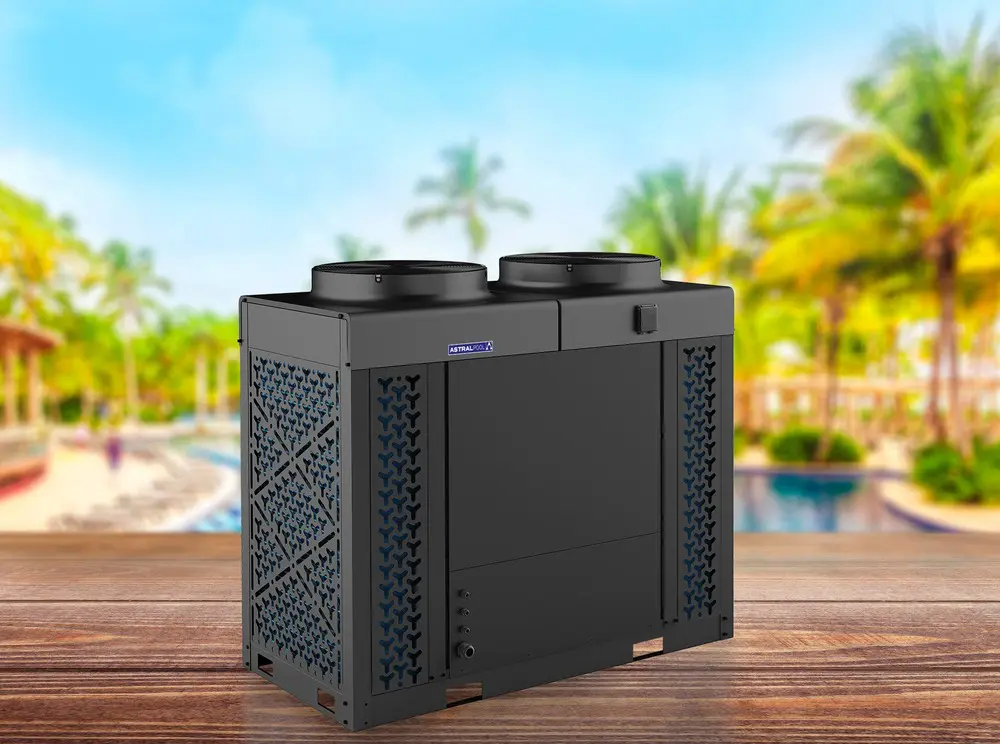
The pool heater stands at the center of a crucial aspect in any swimming pool: adequate temperatures for optimizing bathers’ comfort. When it comes to heating and cooling a swimming pool, traditional systems have become expensive in terms of running costs, especially in an age of increasing energy costs. However, advancements in technology have meant there’s now a smarter and more energy-efficient pool heater solution available: the inverter heat pump.
This type of pool heater relies on aerothermal technology, that is, it employs the thermal energy present in the air. It’s thus an ideal choice that allows for a sustainable and efficient temperature management in swimming pool installations, and it enables operators to extend the bathing season in outdoor swimming pools.
Let’s explore what exactly an inverter heat pump is, how pool aerothermal technology works and its advantages, and why it’s an excellent choice for maintaining a comfortable pool temperature.
Dive deeper with the eBook


 Contact us
 Close form
A commercial swimming pool may seem like a simple structure, but beneath the water’s surface, various factors—including structural loads, waterproofing, chemical treatments, temperature changes, and heavy use—interact. For this reason, choosing pool materials is not merely an aesthetic decision: it determines the project’s feasibility, its maintenance requirements, and its performance throughout its entire service life.
Concrete remains a common solution, but it is no longer the only option. Expanded polystyrene structures, stainless steel, and prefabricated modular systems make it possible to tackle projects with space constraints, tight deadlines, or complex architectural requirements.
The choice must be made after jointly evaluating the location, the type of users, structural loads, water quality, access logistics, and the total operating budget.
What Is the Best Material for a Modern Swimming Pool? Feasibility Analysis
When asked what the best material is for building a swimming pool, the technical answer is that there is no one-size-fits-all option for all projects. The best material is the one that meets the facility’s functional needs with an acceptable level of construction complexity, maintenance, and environmental impact.
A competitive swimming pool must offer dimensional accuracy and durability under continuous use. In a hotel, in addition to durability, design, construction timeline, and architectural integration may take priority. On a rooftop, weight and site access may be the determining factors.
Therefore, pool construction materials must be analyzed as part of a complete system, which includes the structure, waterproofing, lining, water circulation, and finishing elements.
EPS Structures
EPS, or expanded polystyrene, is used in blocks or modules that act like a formwork puzzle and can later be filled with concrete and rebar. Its light weight facilitates transport and handling in spaces where working with conventional systems is more complex.
Among its main advantages is its thermal insulation capacity. This property can help reduce heat loss through the pool walls, especially in heated pools.
It also offers flexibility for creating different geometric configurations and simplifies certain assembly phases. However, EPS should not be evaluated in isolation: the final performance will depend on the concrete, the rebar, the waterproofing, and the proper execution of joints and utility penetrations.
Stainless Steel
Stainless steel is one of the most recognizable materials for modern pools due to its uniform finish, hygienic properties, and contemporary aesthetic. It is used particularly in boutique hotels, wellness centers, therapeutic facilities, and projects where the pool is a central part of the interior design.
Its lightweight, prefabricated structure can reduce on-site construction work. Additionally, it allows for the incorporation of elements such as hydromassage beds, benches, ladders, or hydrotherapy areas within the pool itself.
The selection of the alloy, welds, and water treatment systems must be carried out carefully. Corrosion resistance depends on both the type of steel and the chemical and environmental conditions of the installation. Therefore, material compatibility must be verified as early as the engineering phase.
The Impact of Modular Pools on the Hospitality Industry
Modular pools are transforming the way aquatic facilities are incorporated into hotels, resorts, and existing buildings. Compared to systems built entirely on-site, prefabrication allows part of the process to be moved to a controlled industrial environment.
This can shorten construction timelines, reduce disruption to the facility’s operations, and improve the precision of assembly. The installation of prefabricated pools is also particularly useful on rooftops, in interior courtyards, or during renovations where access is limited.
However, a modular solution does not mean the project is off-the-shelf. Building loads, waterproofing, plumbing routes, joints, and maintenance access points must be evaluated for each specific location.
Bluespring System
Bluespring uses a self-supporting, double-walled modular perimeter structure. It incorporates a large overflow channel that functions as a compensation tank, reducing the need to build additional infrastructure around the pool.
The cavity between the walls enhances thermal insulation and allows for easy inspections. By using prefabricated components and a defined assembly system, it can be adapted to pools of various sizes and shapes.
These features are particularly relevant for hotels with space constraints, pools with an overflow or infinity effect, and projects where the goal is to minimize masonry work. Its final suitability will depend on structural calculations, the building’s configuration, and the pool’s operational requirements.
Skypool Panels
Skypool is based on prefabricated panels that can be installed in both new construction and existing structures. The panels are assembled to form permanent or temporary pools.
The system’s lightweight design makes it ideal for rooftops, stadiums, and buildings where a traditional concrete pool would pose greater logistical challenges and require more time. Industrial manufacturing also ensures high dimensional accuracy, which is essential for sports and competition pools.
In addition, access to the components can simplify inspections and certain repair operations. However, before selecting this system, the allowable loads, support points, corrosion protection, and compatibility with the waterproofing membrane must be verified.
Criteria for Durability, Chemical Resistance, and Sustainability of Materials
When comparing pool materials, the entire life cycle of the facility must be considered, not just the initial cost. Among the most important criteria are:
- Structural durability: the ability to withstand water pressure, ground movement, operational loads, and temperature fluctuations.
- Chemical resistance: performance when exposed to disinfectants, pH, salts, and other compounds present in the water.
- Waterproofing: reliability of membranes, welds, joints, pipe penetrations, and connections to other elements.
- Maintenance: ease of inspecting, cleaning, repairing, or replacing components without extensive work.
- Thermal efficiency: the system’s ability to limit heat loss in heated pools.
- Circularity: the ability to recycle, reuse, or dismantle components at the end of their useful life.
- Impact of construction: amount of waste, transportation required, consumption of raw materials, and duration of construction work.
Sustainability does not depend solely on whether a material is recyclable. It is also related to its durability, the energy required to maintain the pool, and the ability to repair the structure without replacing it entirely. These criteria can be expanded by analyzing other materials and construction systems in eco friendly pools designed to reduce the environmental impact of aquatic facilities.
Likewise, the choice of materials must be coordinated with the pool construction system, the plumbing, water treatment, and architectural design. A good structure will not compensate for poor waterproofing or a facility that is difficult to maintain.
At Fluidra, we develop solutions for commercial swimming pools by taking these interrelationships into account from the earliest stages of the project. A technical analysis of the location, intended use, and operating costs allows us to define a combination of materials and construction systems tailored to each hotel, sports facility, or wellness center, transforming the initial design into a reliable, efficient facility ready for long-term operation.