

 -0.02 (-0.12%)
 Go back
 In the hotel sector, there is one metric that defines whether a hotel is truly profitable: RevPAR (Revenue Per Available Room). Whilst many hotels are obsessed with filling rooms, they ignore a fundamental truth that the smartest owners have already mastered: it is not enough to have occupancy; it also matters how much revenue you generate per available room.
But here’s the secret your competitors don’t want you to know: a well-designed aquatic area, a quality spa or a strategic wellness experience can boost your RevPAR by 25–40% without the need for aggressive rate increases.
In fact, hotels that incorporate swimming pools, saunas and wellness experiences not only fill more rooms: guests pay more for them. Much more.
In this guide, you’ll discover what hotel RevPAR is, how to maximise it, and, most importantly, how to use aquatic amenities as your most powerful weapon for competitive differentiation.
Dive deeper with the eBook


 Contact us
 Close form
What exactly is RevPAR and why is it different from ADR?
RevPAR (Revenue Per Available Room) is a figure that tells you exactly how much revenue you generate per available room in your hotel, regardless of whether that room is occupied or not.
Unlike ADR (Average Daily Rate), which only measures the average price of rooms sold, RevPAR gives you the full picture: it includes empty rooms, occupied rooms and everything in between. That’s why savvy hoteliers use it as a true metric.
Imagine two hotels with the same ADR (€100 per night):
Hotel | Occupancy | RevPAR |
Hotel A | 90% × €100 | €90 RevPAR |
Hotel B | 70% × €100 | €70 RevPAR |
Hotel A earns €20 more per available room each night. In a 100-room hotel, that’s an extra €2,000 a day. Now multiply that by 365 days.
RevPAR combines the two factors that really matter—occupancy and rate—into a figure that doesn’t lie. That’s why it’s the favourite metric of investors, banks, and owners who know what they’re doing.
How is RevPAR calculated? (Simple 2-step formula)
The good news is that calculating RevPAR is incredibly simple. You have two options:
Option 1 (Direct method)
RevPAR = Total accommodation revenue ÷ Available rooms
Option 2 (Quick method)
RevPAR = ADR × Occupancy rate
Let’s look at a real-life example:
Your hotel has 120 rooms. Last night, 75 were occupied at €120 each. That’s €9,000 in revenue.
RevPAR = €9,000 ÷ 120 rooms = €75 RevPAR
Or using the other formula:
RevPAR = €120 ADR × 0.75 occupancy = €75 RevPAR
Both give the same result. Choose whichever is easiest for you.
Important note: If your hotel has a spa, restaurant, swimming pool or other services that generate revenue during a stay, consider using TRevPAR (Total Revenue Per Available Room), which includes ALL revenue, not just accommodation. For hotels with premium amenities, TRevPAR is the metric that shows you true profitability. You can learn more about revenue management in the comprehensive guide to Revenue Management in hotels.
Why is your RevPAR low? The 3 main reasons
If your RevPAR is lower than that of your competitors, the problem lies in one of these three areas:
Reason 1: Too many empty rooms (occupancy problem)
When your occupancy rate drops, your RevPAR drops with it, even if your ADR is good. The solution requires more than just lowering prices: targeted marketing, strategic partnerships with agencies, and off-season campaigns. But here’s the catch: if your hotel doesn’t have the amenities guests want, marketing only brings people to the door—it doesn’t convince them to stay.
Reason 2: Rates too low to compete (ADR problem)
If you’re competing solely on price, you’ll always lose out to large hotel chains. A low ADR is a symptom of an underlying issue: a lack of differentiation. Guests don’t pay more just because they can. They pay more when they perceive value.
Reason 3: Guests aren’t spending on additional services (ancillary revenue)
Here is the shift in mindset that makes all the difference:
A guest who stays the night at your hotel generates accommodation revenue. But that same guest who has access to a quality spa, a spotless swimming pool or wellness experience generates 40–50% more money in total revenue.
Without premium amenities, guests literally have no reason to pay a 5-star rate. A well-designed aquatic area justifies rates that are 20–30% higher. Not because people are stupid. Because they are actually buying different experiences.
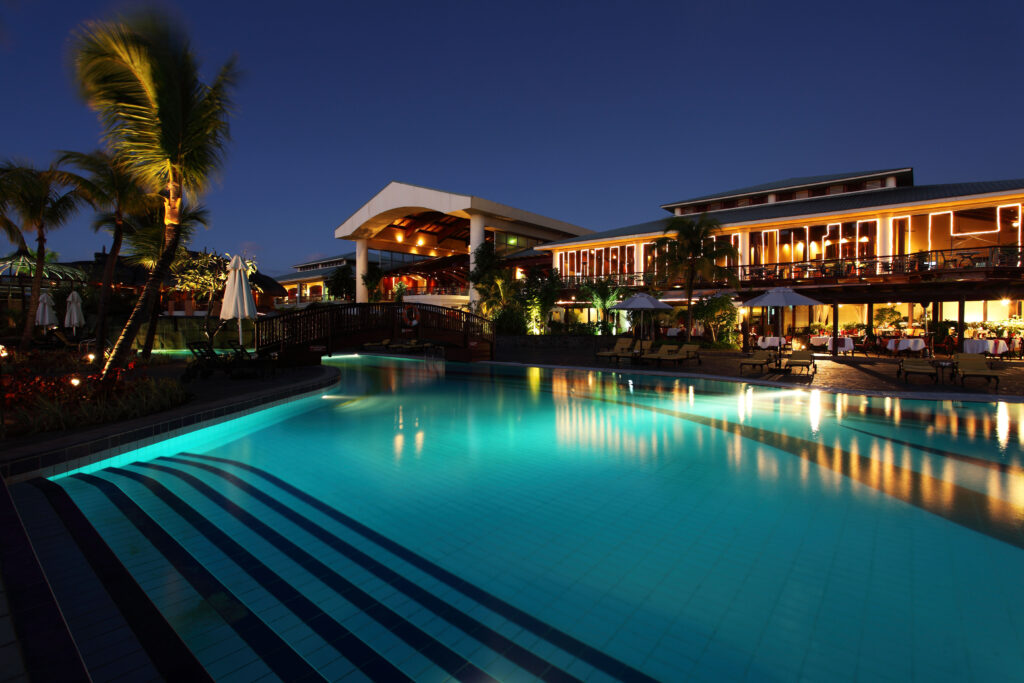
From RevPAR to TRevPAR: The shift that transformed hotels with spas and swimming pools
RevPAR measures ONLY accommodation revenue. It is incomplete. For hotels with a swimming pool, spa, saunas or any aquatic amenity, there is a superior metric: TRevPAR (Total Revenue Per Available Room).
TRevPAR = TOTAL revenue (accommodation + restaurant + spa + pool + events) ÷ Available rooms
What’s the difference?
A 100-room resort with a standard swimming pool might have:
- RevPAR: €85
- TRevPAR: €95
That means only €10 of each room’s revenue comes from ancillary sources. You’re missing out on potential revenue.
That same resort, with an OPTIMISED pool, a strategically positioned spa, and well-structured wellness packages, could have:
- RevPAR: €90 (higher occupancy + higher rates + guests willing to pay more)
- TRevPAR: €135 (€45 extra from ancillary revenue)
Difference: 42% more total revenue per room.
How does this happen? A quality aquatic area is not a cost—it is a revenue generator:
- Upselling room upgrades (“pool view” +€25)
- Bundled packages (“spa + premium room” +€40)
- Day-use of the pool for non-guests (€35–50 for 4 hours)
- Premium events and experiences (weddings, team-building events +€1,000–5,000)
- Cross-selling food and drink by the pool
5 strategies to increase RevPAR (and TRevPAR) with wellness
Strategy 1: Create “Wellness Experience” packages
Before: “Room €100”
After: “Premium Wellness Room €120 + 24-hour spa access + 60-minute massage + gourmet breakfast”
You haven’t raised the price. You’ve created a perception of value. RevPAR rises automatically because guests willing to pay more see a real justification.
Strategy 2: Smart upselling at online checkout
Offer at the time of booking:
- Upgrade to a room with a pool view (+€15-25)
- “Relaxation package” with massage and dinner (+€60-80)
- Early check-in to enjoy the spa/pool (+€25-30)
Data from hotels implementing this show a 6–14% increase in up-sell conversion. That’s pure RevPAR. In fact, revenue management studies show that up-selling is one of the most effective levers for mid-sized hotels.
Strategy 3: Day-use of pool/spa (the goldmine)
At midday, your pool is empty. Generate revenue from local guests:
- €35–50 for 4 hours’ access
- Towel included
- Access to lockers
- Additional drinks and snacks
A hotel with a well-located 200m² swimming pool can generate an additional €800–1,200 per day in the low season. This strategy is particularly effective for modern concrete pools, which allow for easy access and maintenance.
Strategy 4: ‘Wellness Club’ loyalty schemes
Annual membership at €1,500–2,500, including:
- Unlimited access to the pool and spa
- 4–6 nights’ priority accommodation at a discount
- Priority booking, guaranteed upgrades
Result: Predictable revenue + repeat bookings + more stable occupancy = consistent RevPAR throughout the year. Hotels with programmes of this type report increases of 18–25% in occupancy during the low season.
Strategy 5: Automation and quality control
A poorly maintained pool is a reputational risk. A spotless pool is a price differentiator.
Automation and control systems monitor pH, chlorine and temperature 24/7, reducing operating costs by up to 30% whilst ensuring a consistently premium experience. Guests notice it, reviews reflect it, and it translates into higher ADR. Solutions such as those from Fluidra automate this process, ensuring your pool area is always in optimal condition—without daily manual intervention. Result: +15–30% price differential over the competition.
Conclusion
RevPAR isn’t complicated—it’s a direct reflection of two decisions: how many guests you attract and how much they’re willing to pay.
But here is the uncomfortable truth that hotels with low RevPAR don’t want to accept: it’s not just a problem of pricing or marketing. It’s a problem of what you offer.
Without a quality aquatic area, without wellness experiences, without amenities that justify a premium rate, you’re competing on a playing field where large chains will always win.
With well-designed aquatic amenities strategically integrated into your offering, RevPAR becomes what it should be: a measure of success, not survival.
Frequently Asked Questions
What is a good RevPAR for a hotel?
There is no universal “good RevPAR”. It depends on the segment: luxury (€150–300), mid-range (€70–120), budget (€30–60). What matters is your RevPAR Index (your RevPAR vs the competition average). If it’s 100+, you’re gaining market share. <100, you need a strategy. Hotels with optimised spa/pool facilities typically achieve ratios of 110–130.
How can you increase RevPAR without lowering prices?
Create value. Options: 1) Premium amenities (wellness, swimming pool) 2) Strategic bundled packages 3) Dynamic pricing (charge more during peak demand) 4) Marketing without discounts. A hotel with well-designed aquatic amenities ALWAYS sells at a higher rate.
What is the difference between RevPAR and TRevPAR?
RevPAR = rooms only. TRevPAR = ALL revenue (spa, restaurant, events, pool). For hotels with amenities, TRevPAR is the correct metric. A hotel with a RevPAR of €80 but a TRevPAR of €120 means that 33% of its revenue comes from wellness—a source that many overlook. Learn more about TRevPAR in revenue management guides.
How does the quality of the pool/spa affect RevPAR?
Directly. A poor pool = a reputation problem (bad reviews, guest disloyalty). An impeccable pool = a price differentiator (+15–30%). Automated systems ensure consistent quality, which justifies a premium rate and improves occupancy. Result: ADR +15% + better reviews = RevPAR +15–25%.