

 -0.18 (-0.88%)
 Go back
 Great pool construction and renovation projects are not about merely building shells that hold water, but about creating a safe and enjoyable aquatic experience. On top of that, thoughtful pool construction frameworks are capable of ensuring cost-efficiencies for pool operators, with long-term sustainability that keeps facilities thriving for decades.
But effective pool construction doesn’t happen by chance: it’s the result of well thought-of planning that is accompanied by engineering expertise and perfect coordination.
Below is a list of key aspects to consider when developing a pool construction or renovation project. What key design choices must be taken? What are the best pool construction frameworks today? What is the role of project management in pool construction? And how do needs shift for large-scale commercial or public facilities compared to residential projects? Keep reading to find out.
Dive deeper with the eBook


 Contact us
 Close form
Why start by defining the vision and assessing the site?
Building a swimming pool is a complex process that demands structured decision-making. This is especially true for commercial pools where regulations, user flows and operational requirements are more demanding.
Every successful pool construction project starts with a clear brief which delineates the following three fundamentals:
- Who will use the pool? Is it aimed at families, hotel guests, athletes, the general public…?
- What is the primary purpose of the pool? Should it be built for relaxation, wellness, training, competition, leisure…?
- What are the applicable regulations and safety requirements?
Once the main pool construction goals have been specified, it’s time for a proper site assessment, where the following aspects are taken into account:
- Orientation, as solar gain and wind exposure can have an important impact on water temperature, energy efficiency and user comfort.
- Available access routes for users and maintenance staff.
- Space for technical rooms and future expansion.
- Integration with existing architecture and landscape.
By setting a clear vision and taking site potentials and limitations into account from the beginning, pool construction projects position themselves for a great start.
What are the key design and layout considerations for great pool construction?
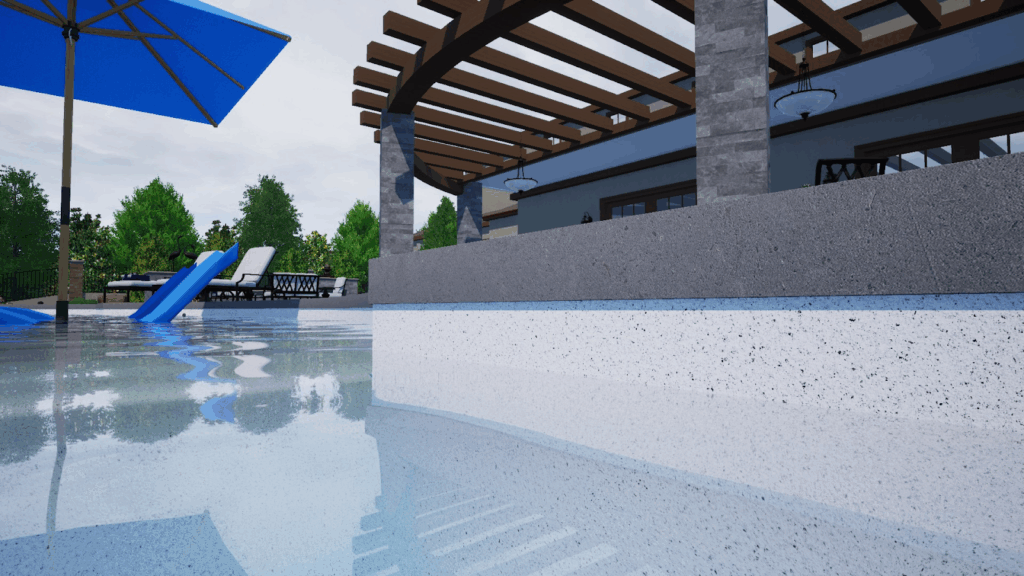
From the initial concepts to the detailed layout designs, the design phase is the critical stage in pool construction where the majority of decisions are made that will determine the pool’s long-term functionality, durability, safety, and overall performance.
It’s important to consider how investing time in design coordination at this stage not only reduces clashes on site and speeds up construction, but also helps ensure a seamless user experience once the pool is open.
As such, this means this phase is fundamental for making key decisions surrounding the hydraulic design, circulation patterns and equipment layout. Choices that, ultimately, must be integrated within a holistic perspective where every element is optimized from the start.
A checklist of key design considerations at this stage involves decisions around:
- Shape, dimensions and depth profiles tailored to expected use. This is the moment to incorporate elements including play areas, lap lanes, diving zones, beach entries, splash zones…
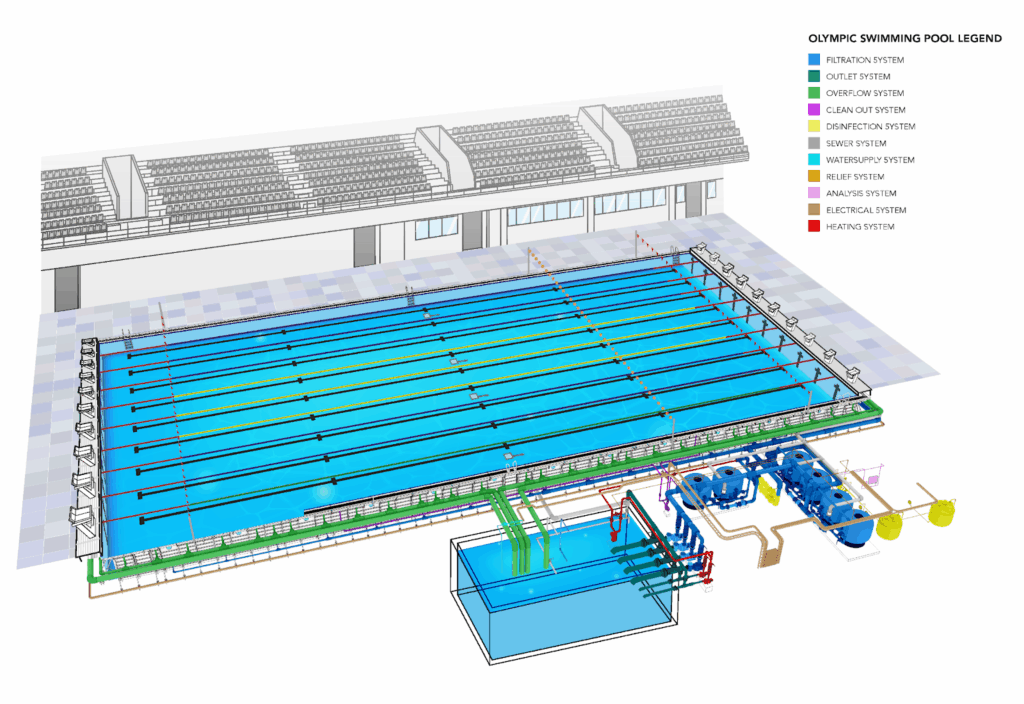
- Hydraulic design that ensures proper technical rooms and uniform circulation, avoiding “dead zones” which can affect water quality.
- Safety and accessibility routes, including steps, ramps and handrails, particularly important in public or hotel pools.
- Surroundings and deck layout, which play a major role in functionality, safety and user enjoyment. This includes elements such as ladders, diving boards, slides, lifeguard chairs, pool lifts and lighting options.
What are the available pool construction systems and how to pick the right one?
When picking the right pool construction system, it’s key to understand that different projects call for different construction approaches:
- Traditional concrete pools offer full design freedom, the possibility of custom shapes and are often good choices for complex commercial projects. This approach also stands out as a very popular and effective option for small scale residential pools.
- Prefabricated panel systems, such as the Skypool modular system by Fluidra, offer fast, accurate and safe construction. An especially valuable approach for competition pools, temporary venues or refurbishments with tight schedules and constrained spaces.
- EPS pool construction (Expanded Polystyrene) is based on this lightweight and highly insulating material that allows for fast and precise pool construction. It is recognized as ideal for prefabricated small sized pools.
- Fiberglass shell pools employ this smooth, non-porous material for surfaces, offering factory-controlled quality and very quick on-site assembly. A combination that makes them ideal for standardized residential projects.
- Stainless steel pool construction options provide exceptional hygiene and design flexibility, combining lightweight modular components with corrosion resistance. As such, it represents a top choice for wellness environments such as hotel spas and sport clubs.
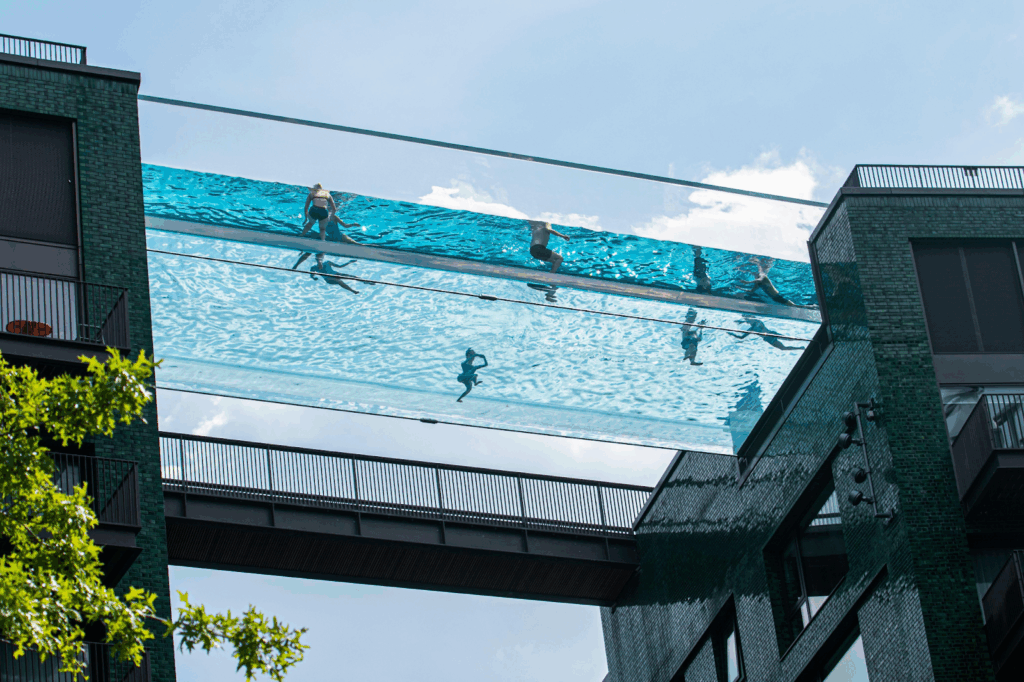
- Acrylic pools employ aesthetic transparent panels, infinity edges and viewing windows to elevate the visual impact of both residential and commercial projects. A popular option for luxury hotels and rooftop settings.
What are the core equipment and smart solutions for pool construction projects?
4.1 Hydraulics and filtration equipment
Pumps, filters and valves are the heart of water circulation for both residential and commercial pools.
With high efficiency and reliability in mind, proper sizing and distribution of this equipment is key. Considering this, variable-speed pumps and properly sized filtration not only improve water clarity and comfort, but they also significantly reduce energy use over the pool’s lifetime.
4.2 Water treatment and sustainability options
Modern pool construction places sustainability at the center, a decision that must be woven into every choice and which has significant implications when it comes to water treatment.
In this regard, advanced water treatment systems such as oxidation processes (AOP), UV-C disinfection, ozone, or salt electrolysis all offer modern alternatives to chlorine water disinfection and reduce reliance on traditional chemicals.
Fluidra water treatment equipment stands out in this context. Recognized worldwide for offering technologically advanced, energy-efficient and durable water treatment solutions, these systems are designed to make pool ownership easier while also supporting efficient cleaning and automated water care systems.
4.3 Comfort, experience and deck equipment
Several equipment options must be considered during pool construction processes for their capacity to enable more cost-efficient operation or effectively extend facilities’ services and possibilities in terms of revenue:
- Swimming pool heating equipment such as heaters and heat pumps extend the season for operators, bringing in additional revenue opportunities.
- LED lighting and water features can be incorporated for those pool construction projects where creating atmosphere and branding opportunities are fundamental, such as hotels and leisure complexes.
- Several accessories for the pool deck enhance both functionality and guest experience, and are widely used by aquatic designers and facility managers worldwide. These include starting blocks, slides, ADA-compliant pool lifts, in-pool furniture and lighting.
4.4 Automation and connectivity considerations
Pool automation has quickly transformed from being regarded as a luxury to become a must-have in modern pool construction projects.
Automation systems allow for a centralized control of pumps, heaters, lights and water treatment, making it easier to maintain water quality, manage energy use and monitor the pool remotely.
As such, the integration of automation technology represents a major step to help operators achieve higher efficiency, safety and consistency in both residential and commercial facilities.
Why integrate project management in pool construction for a seamless building process?
Even the best design and equipment can underperform without solid project management. Conversely, well-managed pool construction or renovation project involves project management techniques, which opens the door to the following advantages:
- Detailed planning and scheduling of civil works, MEP, waterproofing, tile or lining installation, and equipment commissioning.
- Coordination among stakeholders, including architects, engineers, contractors, technical teams and facility owners.
- Quality control and testing, implementing pressure tests, water-tightness tests and verification of flow rates and turnover times.
- Commissioning and staff training, so the maintenance team understands how to operate automation, treatment systems and deck equipment.
What are the differences between residential vs commercial/public pool construction?
While many core principles in pool construction remain the same, the requirements for a small backyard pool are very different from a large municipal or resort facility:
Residential pools (small to medium size)
- The focus is usually on aesthetics, family use, wellness and easy maintenance.
- Equipment is typically simpler, though premium solutions like variable-speed pumps, heat pumps, automation and robotic cleaners are increasingly common.
- Regulatory requirements exist but are generally less complex when compared to public pools.
Commercial and public pools (sports clubs, Olympic pools, hotels, water parks…)
- Bigger scale and more intense usage and bather loads translate into unique requirements, including robust filtration, larger plant rooms, higher turnover rates and redundancy measures.
- Regulation and safety are more strict, including standards related to water quality, lifeguard visibility, emergency access and accessibility (with solutions like lifeguard chairs, pool lifts and starting blocks being crucial).
- Diverse user zones must be planned for, considering how competition lanes, teaching areas, children’s play zones, wellness spaces and slides often coexist in one facility. A characteristic that demands careful hydraulic and spatial design through the right pool construction framework.
- Operational efficiency must be integrated across all pool construction decisions, as design choices must ensure long-term cost control and reliable performance. In the commercial context, automation technologies, energy-efficient equipment and durable components thus become essential as a strategic move to control operating costs and downtime.
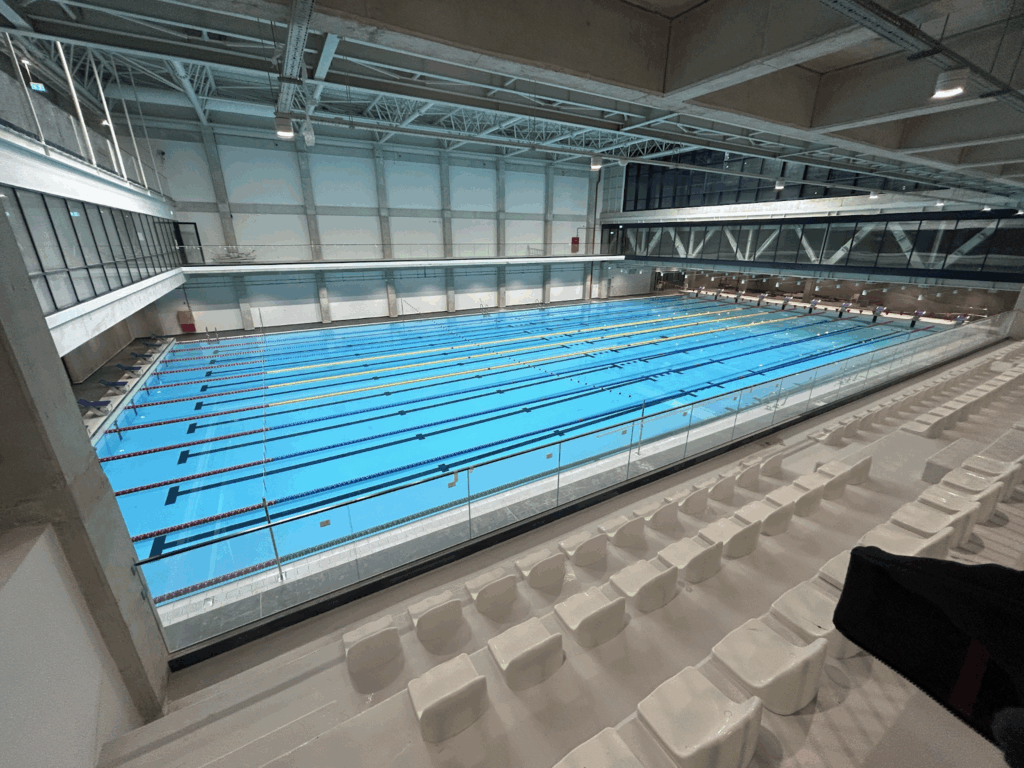
- Precise rules for official competitions should be considered in sport centres and arenas seeking to host official competitions. Compliance with World Aquatics regulations (from pool dimensions to water clarity and sport accessories) thus becomes a core part of guaranteeing top performance.
What are the fundamentals of pool construction?
As a recap for the detailed explanations above, here’s a look at the four pillars that sustain successful pool construction, whether you’re planning a compact residential pool, renovating a hotel rooftop oasis or delivering a new competition venue:
- A clear vision and site-specific design.
- A robust, well-coordinated layout and construction system.
- Carefully selected equipment and smart technologies that are also sustainable.
- Professional project management from concept to commissioning.
In pool construction, reliable partners are at the heart of successful projects, guaranteeing careful planning and coordination to make the project’s vision a reality.
By partnering with Fluidra and its brands AstralPool, Jandy, Zodiac and S.R.Smith, you can turn that vision into a safe, efficient and unforgettable aquatic space—no matter the scale.
FAQs about pool construction
How is a swimming pool constructed?
Swimming pool construction involves a series of operations where, through careful planning and coordination, each step builds on the previous one towards a successful completion. In brief, the project should start from the design phase, where the main goals of the pool and site potential and limitations are taken into account.
From there, the right choice of construction framework will largely determine how the swimming pool is constructed and what the project requirements are. Today, conventional concrete pool construction is available, but other techniques have been developed that allow to speed up projects and minimize downtime (in the case of renovations), without sacrificing quality in results and offering renovated aesthetics. These alternatives include prefabricated options such as the Skypool modular system, EPS pool construction, fiberglass shell pools, stainless steel models and acrylic pools.
What is the most expensive part of building a pool?
Excavation activities are typically the most expensive part of pool construction, as it includes digging and preparing the site and requires heavy equipment and skilled labor. Site conditions and design complexity and add on and increase costs at this stage. On the side of materials, the building of the structural shell is usually the most expensive. Modern choices such as modular systems aim at reducing expenses in pool construction by facilitating on-site construction through prefabricated panels, without compromising on quality.
What are the steps for installing a pool?
While each project and construction framework might present its own needs and required steps, the main stages in pool construction often include:
- Design and planning where the pool’s purpose, size, materials, systems, and compliance requirements are established.
- Permits and approvals.
- Site preparation and excavation according to the approved design.
- Building of pool shell as well as plumbing, electrical, mechanical and filtration systems.
- Interior finish.
- Building of pool deck and surrounding features.
- Final inspections.