

 0.04 (+0.2%)
 Go back
 Salt saunas represent a trend in wellness services in spas, hotels, resorts, sports clubs and wellness centres, both for the health benefits they offer as well as for their striking appearance which adds a level of attractiveness to any environment they are placed in.
They are a modern and innovative solution to expand a business’ wellness services and to attract potential users who are interested in such experiences. Wellness services have been enjoying a steady boom in recent years. Finnish saunas, outdoor saunas and services such as emotional showers have all gained special importance at a time where people are looking to take greater care of the body and mind. In this context, Himalayan salt saunas represent their own trend.
With salt sauna benefits being increasingly popular, below we share some of the key aspects to understand salt saunas and how to approach their design.


 Contact us
 Close form
What are salt saunas?
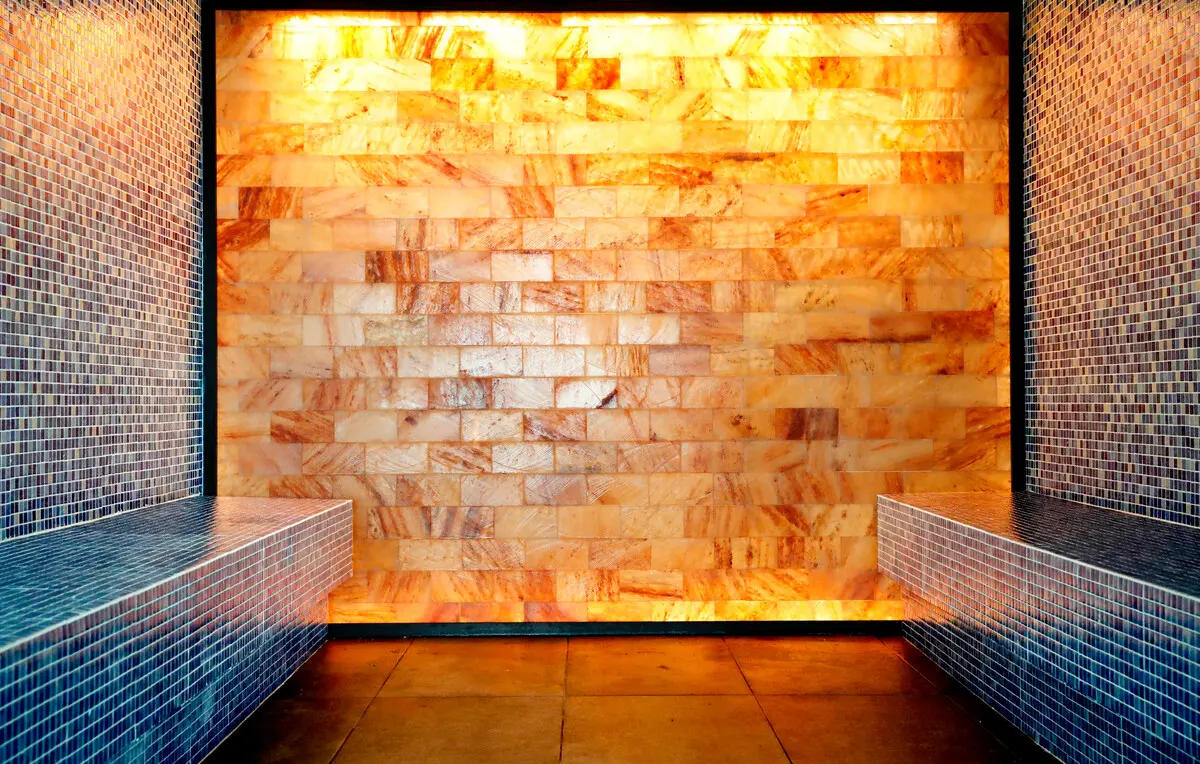
Called both salt saunas and salt cabins, they consist of spaces that have been made with Himalayan salt bricks which have been placed on one or more walls of the sauna to create a salt wall. As such, another term for these therapeutic spaces is Himalayan salt saunas.
The temperature in salt saunas can be anything between 48 and 75ºC, while the relative humidity is between 20% and 50%. These conditions favour the natural process of salt ionization. A salt generator or halogenator is usually installed in the centre of the sauna or cabin. Additionally, the space includes benches or couches on which you can rest, as well as soft and relaxing lighting.
The treatment and wellness experience in Himalayan salt saunas is what is known as halotherapy. It is a complementary therapy which is totally natural. Users breathe in the saline air with its mineral origin, which is thought to underlie the salt sauna benefits, including advantages for respiratory (asthma, bronchitis, cystic fibrosis, sinusitis and seasonal allergies), dermatological, muscular and stress issues.
The duration of the sessions will depend on each particular case, but usually sessions last for 50-60 minutes for adults and 30-40 minutes for children.
Differences between a salt sauna and a salt cave
In the wellness sector there is a wide variety of services and solutions, some of which are very similar. Confusion between salt saunas and salt caves is normal. The latter are normally structures built on natural formations which use microparticles of mineral salt from the same rock which is 100% natural.
The effects are practically the same. In addition to offering a relaxing and peaceful space, they help people with respiratory and dermatological pathologies.
However, salt saunas or salt cabins are specifically designed so that all the elements, including the Himalayan salt, focus on this objective, with the added advantage that they can be custom developed for a wellness centre, hotel, spa or sports club.
What are the salt sauna benefits?
Himalayan salt saunas are currently seeing a rise in popularity for the numerous benefits attributed to them. Below we describe the benefits linked to halotherapy spaces, that is, salt saunas where a halogenator is installed:
- Inhaling small saline microparticles from the Himalayan salt has been linked to improvements in a number of conditions for the respiratory tract. For instance, Wasik and Tuuminen (2021) mention how “clinical trials have confirmed that salt therapy is an effective option for relieving symptoms and improving functional parameters in sinusitis, bronchiectasis, chronic bronchitis, mild and moderate asthma and chronic obstructive pulmonary disease (COPD).” Additionally, a review of available literature surrounding salt therapy found it “improves mucociliary elimination, pulmonary functions and reduces airway’s irritation” (Oleksa et al., 2022)
- Halotherapy has also been linked with beneficial effects on the skin. For instance, Vladeva (2023) describes halotherapy’s positive impacts on “the skin’s ion channels become more active, electrophysiological activity is stimulated, and the skin’s protective properties are enhanced”, all of which facilitate improvements in skin firmness and “the stimulation of repair and regeneration processes in the epidermis and dermis.” Oleksa et al. (2022) also found salt therapy “reduces intensity of the dryness, redness and stimulates regenerative processes in the skin.”
- Halotherapy has also been described as an effective treatment against insomnia, stress and fatigue, with the Himalayan salt sauna creating a soothing environment for users to decompress and relax.
- Halotherapy has also been described as positive for reducing free radical oxidation. For instance, Farkhutdinov et al. (2000) described improvements on free radical oxidation in patients with chronic bronchitis.
What are design recommendations for Himalayan salt saunas?
In order to facilitate the salt sauna benefits described above, these spaces are composed of a range of elements. In addition to the structural, temperature and humidity conditions, aesthetics also take on a special importance to improve attractiveness of Himalayan salt saunas. Quality materials such as spruce wood and panoramic glass fronts make its design stand out, adding to the overall visual appeal and encouraging those who use the sauna to relax.
Aromatherapy, lighting behind the walls and soft music are also used to craft Himalayan salt saunas’ experiences to be both physically and emotionally beneficial.
At Fluidra we design salt saunas and cabins all over the world, adapting to the aesthetic and functional objectives of each wellness centre.
Originally published on March 15, 2022, updated on December 15, 2025.