

 -0.02 (-0.1%)
 Go back
 Water safety involves an integrated, layered set of interventions in pool environments that demand operators to go further than appropriate pool depth and lifeguard presence. As such, water safety in modern aquatic facilities also incorporates notions around:
- Adequate chemical water treatment protocols
- Carefully engineered safety elements and accessories
- Rigorous design in line with regulations
- Advanced supervision equipment tailored for lifeguards
From this perspective, we look at the choices that can be made by pool operators looking for perfect water safety: from modern water treatment systems to technology for drowning prevention.


 Contact us
 Close form
What are the top tips for ensuring water safety in pool environments?
1. Incorporate adequate chemical water treatments
The foundation of water safety lies in maintaining water that is chemically balanced and hygienically safe for bathers. As such, proper management of water chemistry means pool users are protected from microbiological risks and unpleasant side-effects related to chemical treatments (such as eye irritation or respiratory issues), which can compromise their safety and comfort.
When dealing with treatments for water safety, traditional chlorine-based disinfection is still a prevalent choice.
However, modern approaches such as UV-treatment and low-salinity electrolysis (Neolysis) have emerged to offer excellent disinfection while also reducing chemical by-products and irritants in the process, thus improving bathers’ experiences.
At the same time, automated chemical dosing and remote monitoring systems allow for the continuous control of pH levels, ORP (redox), chlorine residuals and flow rates. A modern approach that ensures treatment levels are always within safe thresholds, reducing potential human errors when it comes to water treatments.
2. Consider safety elements and accessories
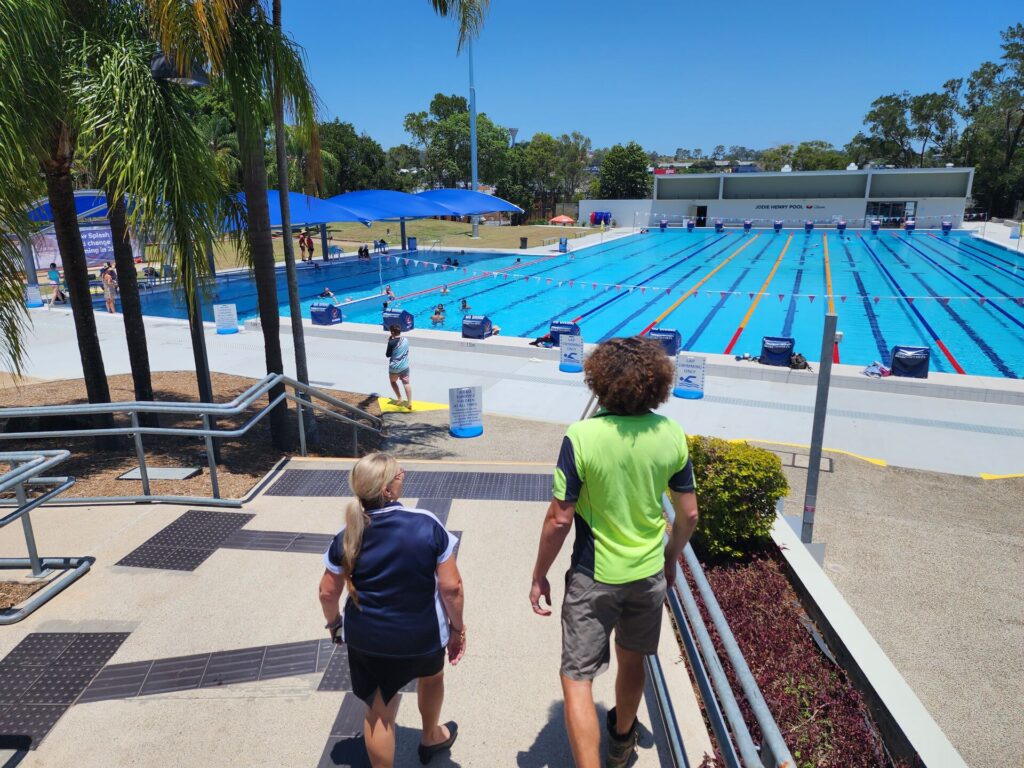
Every physical accessory—from ladders and handrails to diving boards and pool covers—can have an impact on water safety and bathers’ experiences. Considering this, here are the top things to take into account when designing a pool where water safety is a priority:
- As noted in our guide for corrosion protection in swimming pools, degraded pool panels or metallic elements can become structural hazards that compromise pool safety. For this reason, construction materials for pools must be chosen for their capacity to resist corrosion, but also to withstand exposure to chemicals and overall wear.
- A number ofaccessoriescan be installed to mitigate slip and fall hazards, ensure clear visibility, and enable effective evacuation or rescue when required. Included in this category are:
- Anti-slip surfaces
- Adequate lighting
- Visible depth markers
- Emergency signage
- Skimmers
- Overflow systems
3. Design according to safety parameters and regulations
Designing for water safety is closely aligned with complying with national and international safety regulations. Although each regulation demands careful attention to its unique provisions, aspects around water safety that are often seen in such texts include requirements around:
- Structural strength
- Water circulation and filtration rates
- Depth gradients
- Emergency access
- Hygiene standards
4. Design for integrated systems and user dynamics
Pool design for water safety must also consider the different dynamics that emerge when bathers and a diverse array of systems interact in the context of an operating pool:
- Designing the space with users’ dynamics in mind means integrating best practices such as proper hydraulic flow, appropriate water velocities and reliable filtration media. A number of factors that, beyond water safety, have an impact on different pool parameters, including its sustainability and hygiene.
- Engineers and pool managers must consider how the diverse systems implemented in a pool interact, from treatment systems to circulation elements, deck finishes and structural materials. Otherwise, poor design and a lack of integration can undermine the effectiveness of chemical treatments (for instance, by creating dead zones in the basin), as well as lead to rapid deterioration of equipment and accessories, thus eroding safety margins. Smart pool systems emerge as a key solution to overcome this challenge and achieve real system integration.
- The implementation of technologies such as IoT sensors or automation tools can be understood as capable ofenhancing water safety by providing real-time alerts, reducing manual errors and enabling proactive maintenance.
5. Empower lifeguards with pool supervision equipment
Effective supervision represents the final line of defense within the layered approach to water safety we’ve described across the article. As such, the following elements equip lifeguards with augmented capacities for better pool supervision:
- Water safety starts at pool design, which must provide clear sightlines across the pool, unobstructed by glare or structural elements.
- Equipment such as elevated lifeguard chairs, rescue tubes, first-aid kits and AED units must be readily accessible.
- Smart supervision tools support lifeguards in detecting hazards, and include real-time water-quality displays, flow/vacuum sensors and emergency-call systems across the facility.
Additionally, advanced solutions such as Lynxight’s AI drowning prevention system are able to detect unusual and risky movement patterns and then alert lifeguard staff. A tool that effectively extends human capacities for water safety, as it can help design safety protocols based on collected real-life data.
- Integration of supervision equipment with the pool’s chemical-treatment and monitoring platform is also key, as it ensures lifeguards are alerted early to compromised water quality, equipment failure or unsafe conditions.
How can pool environments guarantee water safety for bathers?
To sum up, facility operators can prioritize water safety by adopting a proactive layered approach that understands safety from a holistic point of view. From a practical point of view, this translates into placing the focus on factors like:
- Treating water effectively and considering bathers’ safety and comfort
- Selecting robust and well-designed pool elements
- Designing with safety and regulations in mind
- Equipping lifeguards with the right supervision tools that elevate and complement human capacities.
By addressing all these layers, aquatic facilities can provide a safe, comfortable and compliant environment for users, offering peace of mind for operators while also proactively building the facilities’ reputation as a trustworthy space.
In this quest and as global leaders in the pool industry, Fluidra helps operators build pool facilities with top water safety as a priority.
Frequently Asked Questions about water safety
What is water safety?
Water safety can be defined as the set of measures undertaken around bodies of water to prevent accidents (such as injuries and drowning) from happening. Adequate water safety protocols differ depending on the actual space where they are implemented. For instance, in pool spaces, water safety incorporates a number of different measures, from adequate chemical treatments to the careful design of safety elements and accessories, compliance with regulations and supervision equipment for lifeguards.
What are the 10 water safety tips?
From the American Red Cross to the California Department of Water Resources, a number of organizations coincide in the following 10 water safety tips:
- Knowing how to swim, with basic swimming competencies being how to enter and get out of the water safely, how to get a breath or how to stay afloat.
- Not swimming alone.
- Using protective gear, such as life jackets.
- Following directions and signs as posted on each swim spot.
- Always swimming in designated areas that are watched by a lifeguard.
- Remaining aware of your own limitations and capacities as a swimmer.
- Adjusting to the conditions of the swimming spot, including the presence of currents or slippery surfaces, among other risks.
- Taking precautions when diving and leaping, as well as avoiding dangerous drop-offs.
- Only swim while sober.
- Knowing how to call for help.
What is the first rule of water safety?
Among the top tips for water safety, the first rule before entering water is having adequate swimming competency. This involves knowing:
- How to enter safely.
- How to catch a breath when in water.
- How to stay afloat.
- How to move across the water.
- How to get out of the water safely.
Together with this, it’s also important to develop awareness around each person’s level of competency in swimming, and adjusting behaviour depending on the actual conditions on the swimming spot.