

 -0.1 (-0.56%)
 Go back
 Zero edge pools have been the trend in the leisure sector for decades. Closely linked to infinity pools and negative-edge pools, these are all options that go beyond conventional pool aesthetics enhancing a sense of luxury and space by creating seamless visual effects.
This type of aquatic facility became a synonym of exclusivity since the infinity pool of ‘Diamonds are forever’, the seventh James Bond film. Once the reserve of the elites, scroll the social media profiles of the rich and famous and an image of them relaxing in a seemingly unending expanse of water is bound to come up.
In this way, many associate zero-edge pools with quality of life and well-being. And, indeed, they have become a major attraction, helping businesses to enhance their brand image, exclusivity and attention to detail.
But what exactly is a zero-edge pool? How is it different from negative edge pools or infinity pools? And what are the best zero-edge pool ideas and design tips? Keep reading to find out.
Dive deeper with the eBook


 Contact us
 Close form
What is a zero edge pool?
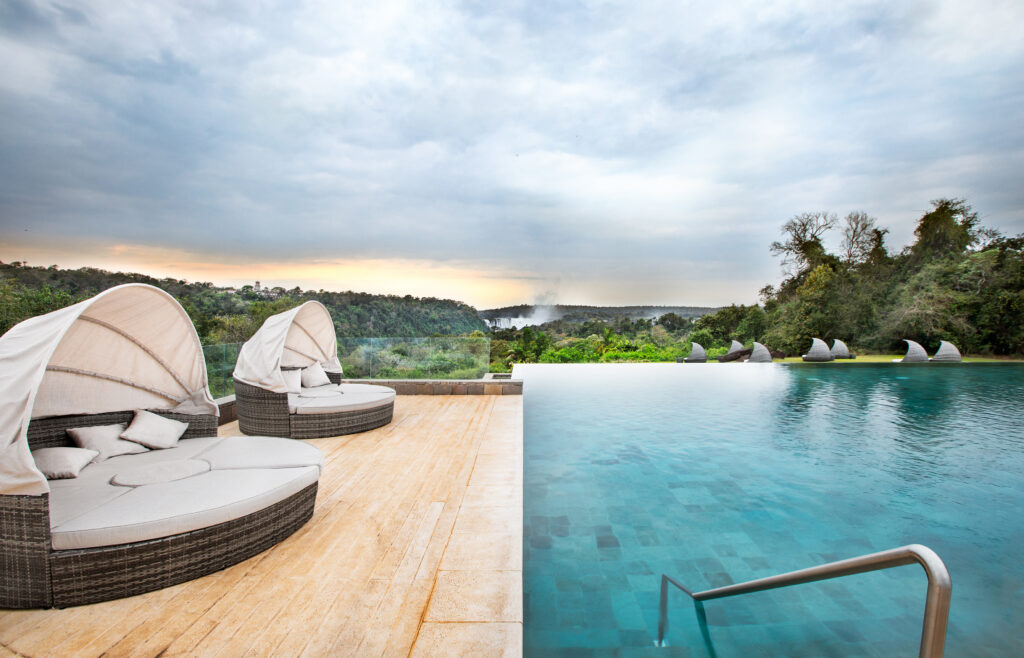
A zero-edge pool is a type of swimming pool designed so that the water level is flush with the edge. This creates a seamless, level appearance, merging water with its surroundings.
This is done by allowing the water to spill over the edge into a collection trough that filters and recycles the water. The impression, when done right, is of a pool of water that continues into the sky. It can transform the swimmer away from themselves and make them feel like they are floating in space.
Negative edge pool and infinity pools: other approaches to zero-edge pools
A negative-edge pool or infinity pool is built to emphasize a pronounced drop-off or slope at one of the edges. A design feature that is also referred to as “vanishing edge”, it allows water to spill down a wall or slope, creating a strong visual effect where water seems to extend into the horizon.
One thing to be aware of, though, is that these kinds of pools work best in places with a dramatic view. Zero edge pools can complement the wide horizon of a spectacular mountain or sea vista fantastically well, creating an immersive experience for users.
What is the difference between zero-edge pools vs. negative-edge pools
Zero-edge pools rely on creating a continuous, smooth transition between pool water and the perimeter surfaces. Meanwhile, negative-edge pools or infinity pools are designed so that pool water smoothly flows towards one edge and then disappears, creating a sort of waterfall effect.
What are zero-edge pool ideas and design tips?
Zero-edge pools are a specific type of aquatic facility with the following features and requirements:
- Water temperature may differ depending on the environment. Thus, a specific study for each project is needed to determine it.
- The infinity pool should ideally have a depth of 1.2 to 1.6 metres. A greater depth would not allow the user to enjoy the view.
- Recirculation of water. It depends on the use being made of the zero edge pool. For example, following the British regulations and water treatments, for a depth of 1.2 to 1.6 metres, the water will take 2 hours to recirculate.
- Regarding the water treatment, again, depending on how the swimmer intends to use their pool, we can install different water treatment systems. A traditional water treatment system will work perfectly with our recommended pool depth, but it can accommodate different configurations.
- The construction system will generally be either concrete, stainless steel or a system of panels and combined with acrylic windows.
- On the subject of regulations, it becomes essential to do a custom design for each project that complies with the regulations currently in force.
Why should you install a zero-edge pool or an infinity pool?
Well-designed zero-edge and infinity pools complement landscapes and properties, representing a sure way to increase attractiveness and add value to any leisure or tourist location.
It is a facility that enables users to live a sensorial experience by enjoying the breathtaking views while relaxing in the water. Hence, this type of pool is usually related with feelings of well-being, relaxation, calm and the appreciation of a landscape’s beauty. Moreover, it is also associated with exclusive spaces, given that some of the most popular are located in exclusive hotels and resorts. As such, it represents a distinct option linked to unique benefits and branding opportunities, just like artificial lagoons and lakes for resorts offer their own advantages.
Therefore, infinity pools do not only carry benefits for users, but they also add long term value to any property where they are installed, making it easier to differentiate from the competition and increasing the market value. In addition, they provide a source of competitive advantage, enhancing a property’s uniqueness and increasing the value perceived by customers and potential investors.
Frequently asked questions about zero-edge pools and infinity pools
How does a zero-edge pool work?
A zero-edge pool is designed so that the water level is exactly flush with one or more edges of the pool. In order to do so, a hidden catch basin or trough is incorporated. This element is in charge of collecting water; meanwhile, water pumps are used to recirculate water back into the pool.
How does an infinity pool work?
In an infinity pool, water spills over one or more edges of the pool, often aligned with surrounding elements and views. This implies the overflow edge is slightly lower, so that water naturally flows in that direction. Meanwhile, a recirculation system is included, via a hidden catch basin or trough, where overflow water is collected and then pumped back into the pool.
What are common problems with infinity pools?
- Structural problems can arise in infinity pools, especially those in rooftops and other elevated locations. Professional design and installation should ensure the right structural strength principles are applied to avoid such problems.
- Safety issues related to perception around the vanishing edge can arise, with swimmers having difficulties to gauge the pool’s depth. Clear markings and transparent barriers can be installed to ensure swimmers are aware of perception differences with conventional pools and remain alert. Additional security measures should be considered to avoid accidents for children and pets.
Overflow basins should be properly maintained to avoid issues regarding hygiene and safety.