

 -0.52 (-2.34%)
 Tornar
 Natural swimming pools use biological filtration instead of chemicals to maintain pristine water quality. This sustainable approach combines elegant design with ecosystem-based water treatment, offering hotels, wellness centers and private pools a unique amenity that appeals to environmentally conscious guests while reducing long-term operational costs.
Have you ever wondered what makes swimming in a mountain lake feel so different from a conventional chlorinated pool? The answer lies in nature’s own purification system. A natural swimming pool brings this same refreshing experience to your facility by using aquatic plants and beneficial microorganisms instead of chlorine and chemicals. As sustainability becomes a priority for commercial properties worldwide, these chemical-free pools are transforming how hotels, wellness centers and residential pools approach aquatic design.
Unlike traditional pools that rely on chemical treatments, natural swimming pools work with nature rather than against it. They create a self-sustaining ecosystem that not only keeps water clean and safe but also provides a more pleasant swimming experience for guests.
Submergeix-te més amb l’eBook


 Contacte
 Tancar
What is a natural swimming pool?
A natural swimming pool is a chemical-free swimming facility that uses biological filtration—through plants, microorganisms, or both—to purify water naturally. The pool consists of two distinct zones: the swimming zone where people swim, and the regeneration zone where biological cleaning happens. Water continuously circulates between these areas, getting naturally purified.
There are two main approaches. Traditional designs use aquatic plants that filter nutrients while adding oxygen. Modern systems use a biofilm filter—a compact system where beneficial microorganisms do the cleaning work without plants. Both approaches meet or exceed health and safety standards while eliminating harsh chemicals.
The concept originated in Austria in the 1980s and is now increasingly common in hotels, wellness facilities, and private pools worldwide.
How do natural swimming pools work?
Natural swimming pools rely on biological filtration—beneficial microorganisms and sometimes plants work together to remove contaminants and balance nutrients. The system operates as a closed-loop with continuous circulation.
A pump moves water from the swimming zone to the filtration zone, where it gets cleaned, then returns. This constant water circulation prevents stagnation and ensures mosquitoes can’t breed.
Beneficial microorganisms form biofilms that consume organic matter, break down nutrients and outcompete harmful bacteria. Good bacteria consume nutrients that would feed algae, while oxygen levels stay healthy through water movement and photosynthesis (in plant-based systems).
Many natural swimming pools also includemechanical filters and phosphate dosing for greater control of water quality. Some even include disinfection with UV-C rays and/or low-salt hydrolysis to destroy unwanted bacteria suspended in the water, taking the clarity of natural swimming pool water to the next level.
What is a biofilm filter and how does it differ from plant-based systems?
A biofilm filter is a plant-free system where microorganisms do all cleaning work. Water flows through a chamber containing filter media (gravel, ceramic or plastic elements). Beneficial bacteria colonize these surfaces, forming a biofilm that processes contaminants.
Key advantages: smaller footprint (filter fits under a deck vs. plant zones requiring 30-50% of pool area), faster water circulation, and ideal for commercial applications with higher bather loads.
Comparison: Plant-based vs Biofilm Systems
| Aspect | Plant-Based System | Biofilm System |
| Space Required | 30-50% of pool area | Compact filter (<5% of pool area) |
| Aesthetic | Natural, pond-like | Contemporary, modern designs |
| Maintenance | Plant care, trimming | Equipment maintenance |
| Best For | Resort settings | Urban hotels, rooftop pools |
What are the design options for natural swimming pools?
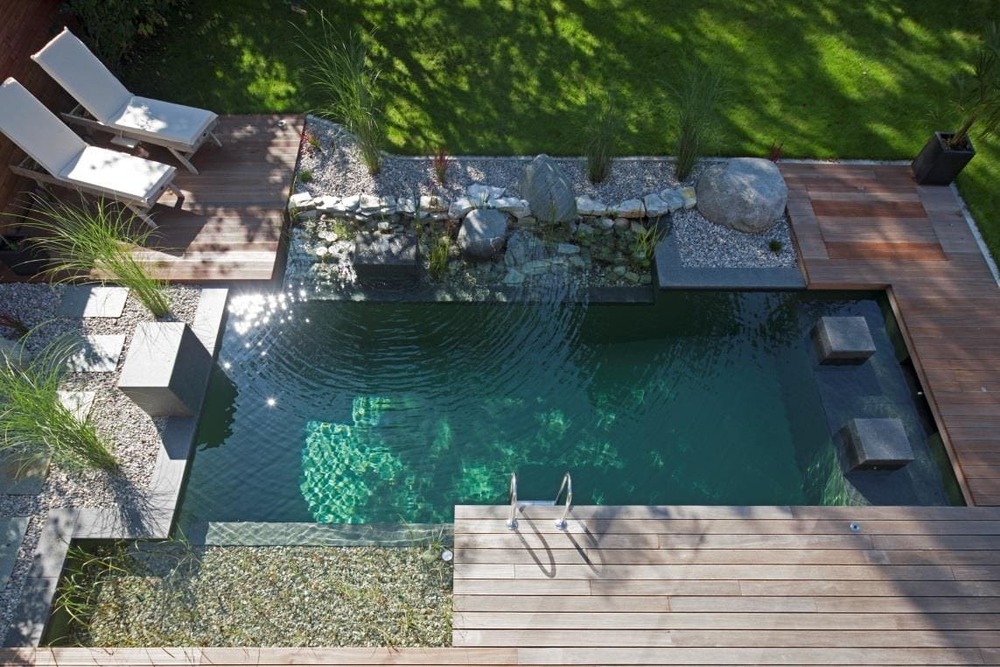
Natural swimming pools offer remarkable design flexibility—from organic, naturalistic designs to sleek contemporary installations. With biofilm systems, pools can appear completely conventional (rectangular, L-shaped, infinity edge) while operating on natural principles.
Sizes range from intimate plunge pools (minimum 30 square meters) to large-sized leisure and swimming installations. Indoor installations are popular in wellness centers, offering year-round chemical-free swimming.
Why are hotels and commercial facilities choosing natural swimming pools?
Natural swimming pools deliver strategic benefits: marketing differentiation, operational savings, guest wellness and sustainability credentials.
Swimmers report natural pool water feels softer on skin and eyes—no chemical smell, stinging, or dry skin. This aligns perfectly with wellness center positioning.
While initial costs run 20-40% higher than conventional construction, operating costs drop 30-50% over the pool’s lifetime. You eliminate chemical purchases, reduce water consumption, and benefit from lower energy costs.
Hotels can command premium rates for rooms with natural pool access. The pool becomes part of the facility’s brand story and sustainability commitment.
How much does a natural swimming pool cost?
Natural swimming pools cost 20-40% more to install but recoup this within 3-5 years through operational savings.
For commercial pools (100-150 m²), expect €70,000-€150,000 installation. Variables include design complexity, filtration system choice, and site conditions.
Operating costs compared to conventional pools
Operating costs run 30-50% lower: €2,000-€4,000 annually vs. €4,000-€8,000 for conventional pools.
Savings breakdown:
- Chemical costs: Drop to zero (conventional pools: €3,000-€8,000/year)
- Water costs: Decrease 40-60% (no backwashing needed)
- Energy costs: Drop 20-30% (lower flow rates required)
- Equipment lifespan: 15-20 years vs. 10-12 for chlorinated systems
Over 20 years, that’s €40,000-€80,000 in savings.
What maintenance do natural swimming pools require?
Natural swimming pools require different maintenance—you’re managing an ecosystem rather than chemicals.
Daily (10-15 min): Visual check, pump operation, remove debris
Weekly: Skim surface, brush walls
Monthly: Check system performance, vacuum sediment
Seasonal: Plant trimming/system restart (temperate climates) or filter cleaning every 2-3 years (biofilm systems)
The first year requires closer attention as the ecosystem establishes itself.
Are natural swimming pools safe and hygienic?
Yes. When properly designed, natural swimming pools meet or exceed health and safety standards—without chemicals.
Water quality testing shows natural pools maintain safe bacterial counts. Beneficial microorganisms outcompete pathogens by consuming the nutrients harmful bacteria need. Continuous circulation prevents stagnant conditions where harmful bacteria thrive.
For commercial facilities: regular water testing, circulation documentation, and in some jurisdictions, backup UV or ozone systems.
Mosquitoes: Not an issue. They require still water for breeding—larvae can’t survive in circulating water.
Can you convert a conventional pool to a natural swimming pool?
Yes. Converting existing pools is feasible and costs 40-60% of new construction since the basin exists.
Two approaches:
Biofilm retrofit (limited space): Install biofilm filter in equipment room, modify plumbing. Pool appearance stays the same.
Regeneration zone addition (with space): Partition existing pool or excavate adjacent area for planted filtration zone.
Timeline: 4-8 weeks
Costs: €30,000-€80,000 for 100m² pool
Payback: 3-5 years through operational savings
How do natural pools compare to saltwater and conventional chlorine pools?
Comparison Table: Natural vs Saltwater vs Conventional Pools
| Factor | Natural Pool | Saltwater Pool | Conventional Chlorine |
| Initial Cost | 20-40% premium | 10-20% premium | Baseline |
| Annual Chemical Cost | Minimal | Low | Moderate |
| Water Usage | Very low | Moderate | Moderate |
| Swimmer Comfort | Excellent (no chemicals) | Good | Regular |
| Environmental Impact | Very low | Low | Regular |
| Marketing Value | High (unique) | Moderate | Moderate |
Natural pools make most sense for hotels and resorts prioritizing sustainability and uniqueness, wellness centers where chemical-free aligns with holistic health positioning, facilities implementing water conservation strategies, and properties with environmentally conscious guests.
Frequently asked questions
Do natural swimming pools attract mosquitoes?
No. Continuous water circulation prevents mosquito breeding—they require still water. If mosquitoes appear, it indicates circulation failure, not an inherent problem.
Can you heat a natural swimming pool?
Yes, using heat pumps, solar, or gas heaters. Biofilm systems handle heated water better than plant-based systems. Size filtration appropriately for expected temperature.
Are natural pools more expensive than regular pools?
Initial costs are 20-40% higher (€70,000-€150,000 for commercial pools), but annual operating costs are €2,000-€4,000 vs. €4,000-€8,000 for conventional pools. Total 20-year ownership cost is often lower due to eliminated chemicals, reduced water use (40-60%), and lower energy costs (20-30%).
All cost estimates provided in this article are indicative and may vary depending on the project and installation in question.