

 -0.05 (-0.25%)
 Go back
 Standard pool sizes required by the World Aquatics apply for competition pools, which can employ current technologies to meet these rules while accessing cost-efficient, quality water installations
The term standard pool sizes typically applies for competition pools that must align with official World Aquatics requirements. A set of standards that ensure official sport events take place in homogeneous environments that promote the athletes’ performance, health and safety.
Today, next-generation technologies are pushing versatility in pool design, allowing operators to comply with standard pool sizes while also offering a unique, outstanding experience to competitors.
In this article, we look at what are the current standard pool sizes while also considering what is the most efficient way for operators to comply with them and generate reliable, efficient installations. Keep reading to find out.
Dive deeper with the eBook


 Contact us
 Close form
What standard pool sizes are there for competition pools?
In the case of competition pools intended to host official events, pool design will need to comply with the international standards and regulations established by the World Aquatics (known earlier as the International Swimming Federation or FINA).
The main indications around standard pool sizes are established in this organization’s“Facilities Rules”,which include the standard pool sizes, depth, temperature and pool accessories (among other parameters).
At the same time, pool shapes and sizes can vary greatly depending on the installations’ intended use and type of competition it is intended to host:
Standard pool sizes for Olympic pools
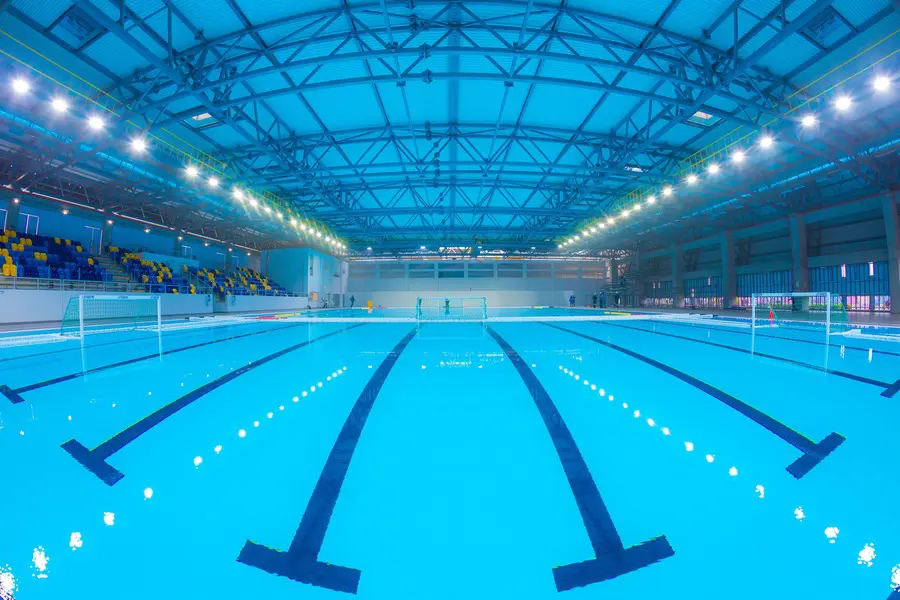
The largest type of swimming pool, it’s commonly used for official swimming competition events. Typically integrated in big sport clubs and complexes, its design needs to comply with the following standards and regulations set forth by World Aquatics:
- Length: 50 metres.
- Width: 25 metres.
- Depth: a minimum of 2 metres. Today, the recommended depth has expanded to 3 metres, as an increased depth prevents a rebound while swimming, making the surface of the water more stable.
Regarding Olympic pools with starting blocks, they must have a minimum depth of 1.35 metres extending from the first metre to 6.0 metres from the end wall. A minimum depth of 1.0 metres is required for the rest of the pool.
- Walls: the end walls must be vertical, parallel and form 90-degree angles with both the swimming lane and the water surface. They must be made of solid materials, and include a non-slip surface extending 0.8 metres below the water surface, so that competitors can push off the wall without danger.
Lanes: standard pool sizes establish a lane width of 2.5 metres. Additionally, 0.20 metres must be left in the space between the wall and the floating line of the first lane, and the last lane and the wall. This distance mitigates the potential ripple effects on swimmers.
Standard pool sizes for semi-Olympic pools
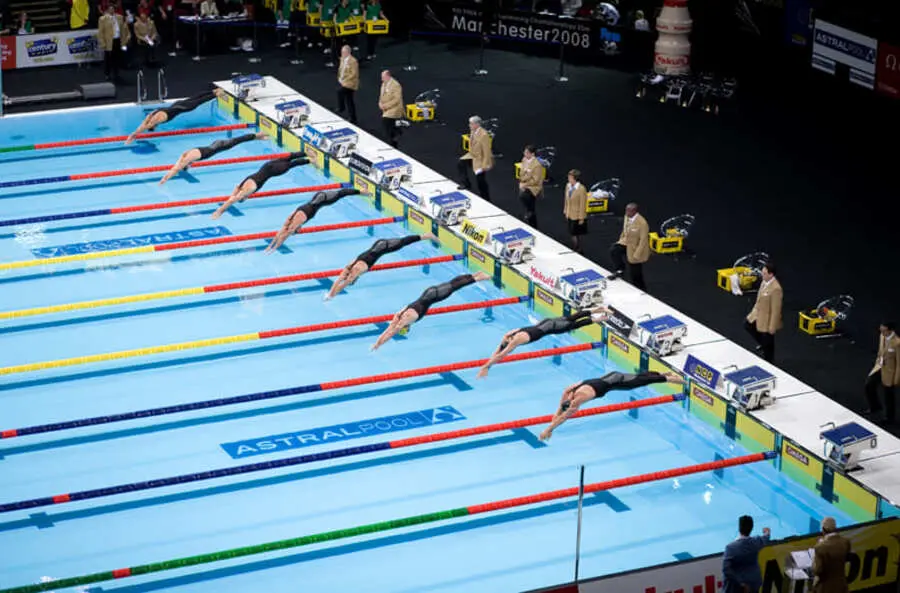
Commonly intended for short-course swimming competition events and training in state-of-the-art sports clubs, the semi-Olympic pool is also known as a short pool, as it is exactly half the length of an Olympic pool.
There are a number of requirements defined by World Aquatics Facilities Rules for semi-Olympic pools aiming at hosting 25-metre competitions:
- Length: 25 metres, including the potential incorporation of timing touch panels at starting walls or turns.
- Depth: the minimum depth is 1.80 metres. Pools with starting platforms must be at least 1.80 metres deep and the distance from the wall boundary must be between 0 to 6 metres.
- Wall: end walls must be vertical, parallel and form 90-degree angles with the swimming lane and the water surface. Just like standard pool sizes for Olympic pools, walls here must also be made of solid materials and present a non-slip surface extending 0.8 metres below the water surface.
- Lanes: it must be at least 2.5 metres wide, so that between 8 and 10 lanes can be included in 25-meter semi-Olympic pools. In order to mitigate ripple effects that might trouble swimmers, a space of 0.20 metres must be ensured between the wall and the floating line of the first lane, the last lane and the wall.
Standard pool sizes for diving pools
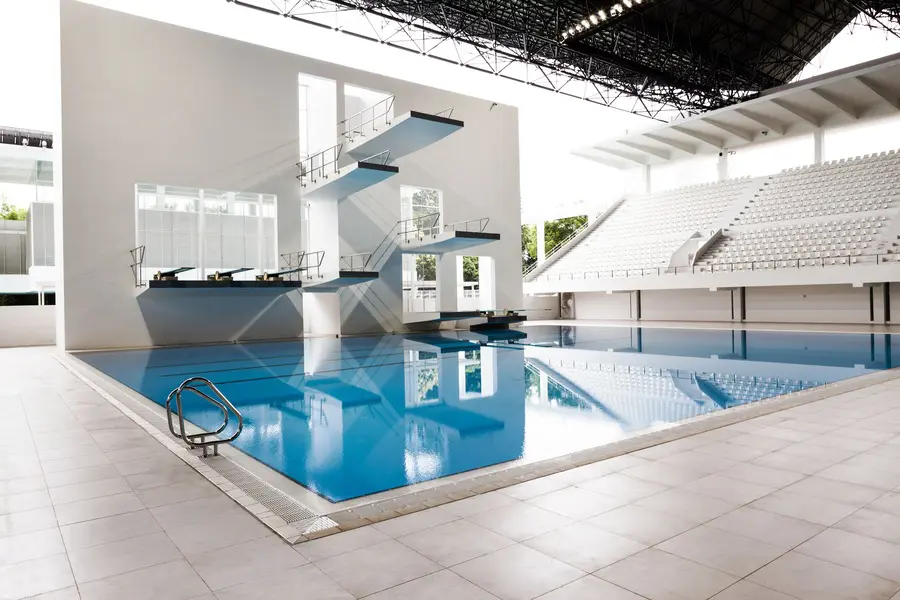
Designed for the practice and competition of jumping, trampoline and platform dives, they’re usually found in large sports complexes or sports clubs for high-level training.
The following standard pool sizes have been established by World Aquatics to guarantee athletes’ safety in diving competitions:
- Size: a minimum of 25 metres x 21 metres.
- Depth: 5 metres at the shallowest end.
- Diving platform: it must create a single, isolated enclosure along with the swimming pool, providing protection from the reach of prevailing winds that disturb the divers. When platforms are used, their minimum length is 6 metres and a width of half a metre. The front part of the platform, where the competitors stand before their jumps, must project at least 1.5 metres from the edge of the pool.
- Trampolines: a minimum length of 4.8 metres and a width of half a meter are required. A non-slippery surface must be incorporated.
Standard pool sizes for high-diving pools
The fundamentals of high diving are closely related to the discipline of platform diving. However, there are two basic differences between diving and high diving: the fact that high-diving athletes land feet first and an additional height (the World Aquatics has established heights of 20 metres for women and 27 metres for men in high diving competitions)
High diving can be performed from a cliff or artificial platform into the sea, a lake, a river or an artificial pool. In the case of pools, it is preferably performed in controlled environments with custom fabricated diving towers in conjunction with fabricated pools that comply with the following standard pool sizes:
- Shape: while rectangular dimensions are the preferred option for permanent artificial pools, temporary round pools can also be used.
- Size: rectangular pools must present a minimum width of 17.50 metres and a length of at least 14 metres from the plummet to the front walls. Round pools must present a minimum diameter of 17 metres.
- Depth: the minimum is 5.80 metres, although legacy pools built prior to December 2017 are allowed to be 5 metres deep.
- High diving platform: this pool accessory must be rigid, horizontal, 2 metres wide and 5 metres long. Additionally, it must be covered with an anti-slip material.
Standard pool sizes for water polo pools
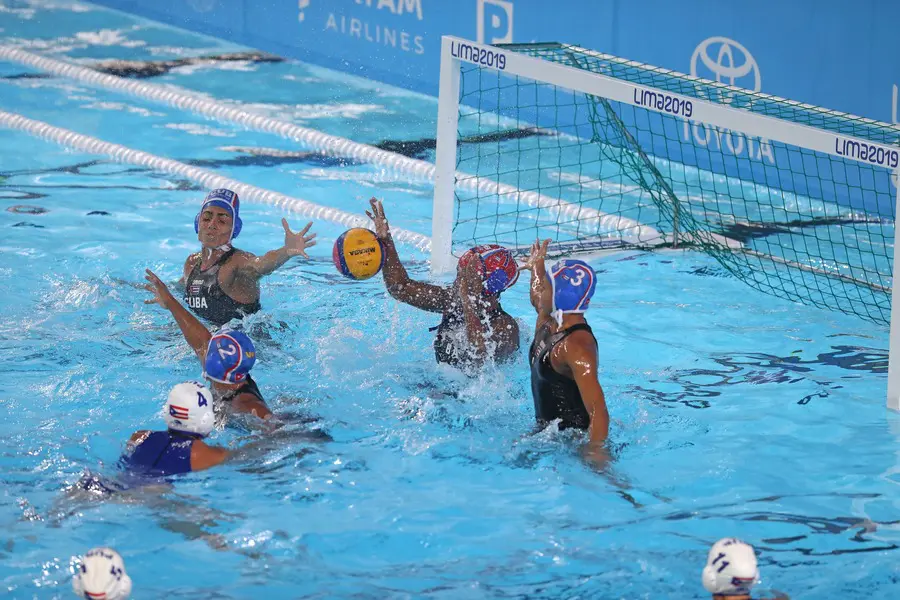
Standard pool sizes for water polo pools must take into account that water polo swimmers mustn’t be in contact with the pool’s bottom, staying afloat at all times.
It’s common for water polo competitions to take place in adapted Olympic pools where ropes are installed to mark out the field size standards, as well as all required competition accessories:
- Size: as established by World Aquatics standards, dimensions vary according to whether the installation holds men’s or women’s competitions. For men’s water polo, the field of play must be 33 metres long (measuring from one goal line to another) and 20 metres wide. Women’s water polo field must be 25 metres long and 17 metres wide.
- Depth: In both cases, the pool’s depth must be 1.8 metres, guaranteeing players don’t touch the vessel’s bottom.
Standard pool sizes for artistic swimming pools
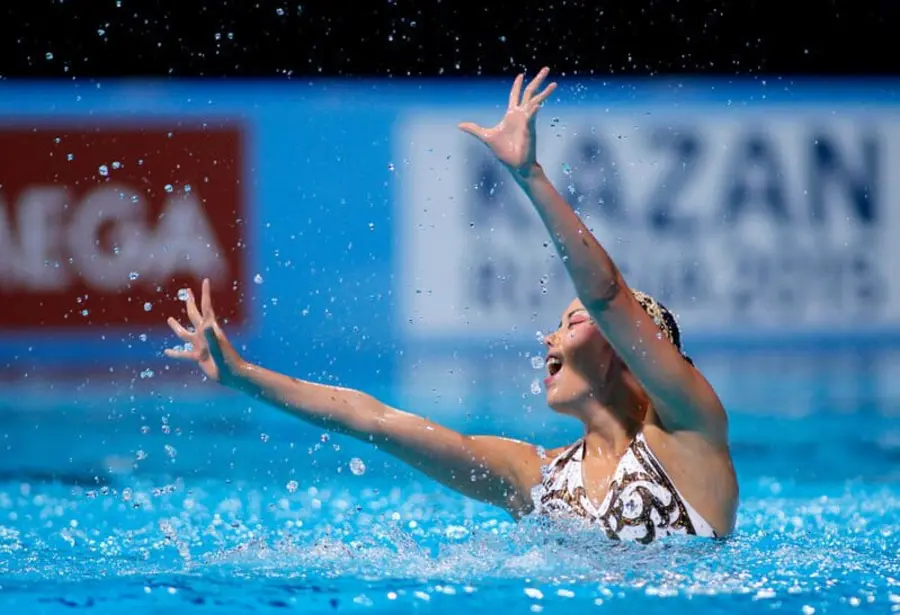
Artistic or synchronised swimming is an individual or collective competition that takes place in competition pools complying with the following standard pool sizes:
- Size: a minimum of 30 metres by 20 metres.
- Depth: not less than 3 metres.
- Starting platforms: 0.7 metres high platforms with a tolerance of ±1cm are required. The minimum width is 4.00 metres, while the platform’s surface must be covered in a slip-resistant material that simulates a quick-drying waterproof carpet.
Standard pool sizes for warm-up pools
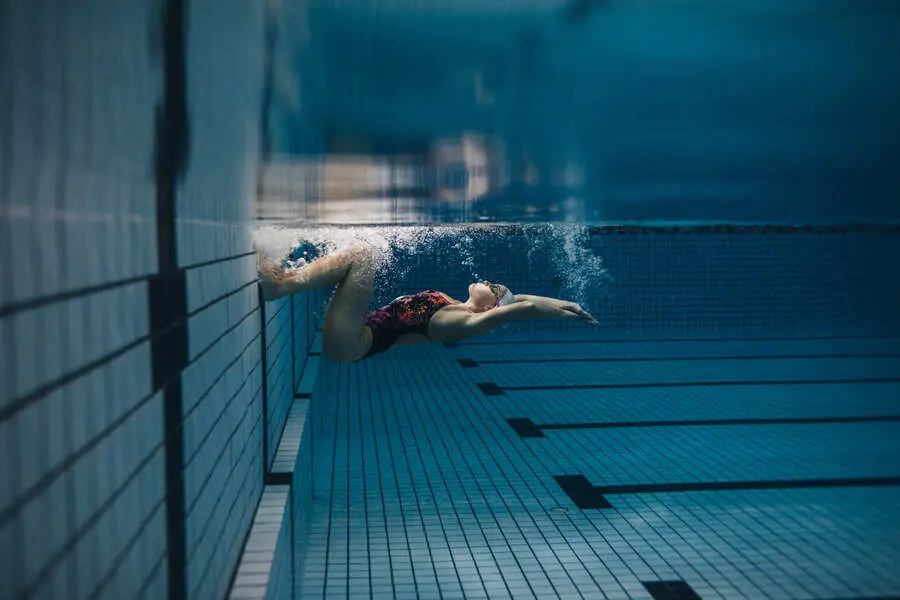
A warm-up pool is specifically designed for competitive training sessions before or during a competition. As such, they may include accessories such as starting blocks or podiums, lane lines and backstroke signs, all of them complying with the same World Aquatics regulations as Olympic or semi-Olympic swimming pools.
Other common sizes for this type of pool include:
- For standard swimming warm-up pools: a rectangular shape a minimum length of 25 metres and a minimum depth of 1.8 metres.
- For pools devoted to artistic swimming: standard pool sizes here include a vessel must of 25 x 25 metres or 30 x 20 metres. Depth must be 3 metres.
What best practices in pool design should complement standard pool sizes requirements?
Expertise and know-how in building a pool play a crucial role in the experience that users will encounter when water installations are in operation. In fact, good pool design has a major impact on all types of pools, but has a particular effect on competition pools and their users, including athletes and daily sports club users.
Today, a number of innovations have emerged that allow pool operators looking to comply with standard pool sizes to do so while also prioritizing cost-efficiency and ease of operation:
1. Use panel building systems
Precise and reliable design as well as construction techniques can greatly facilitate a pools’ building process and later operation and maintenance.
Today, panel building systems are considered an ideal option to build reliable pools while significantly cutting down on construction costs and times as well as maintenance needs.
Pool building solutions such as Skypool modular panels stand out as advanced pool-building technology that provides the following benefits:
- Quick installation and potential easy disassembly that doesn’t require complex civil works.
- Adaptability and reliability, guaranteeing tolerance to seismic movements.
- An easy anchoring and assembly system that ensures complete watertightness.
- Excellent antioxidant protection guaranteed by the use of galvanised steel panels, which translates into enhanced durability and safety.
- Lightweight and millimetric precision that is also ideal for temporary competition pools certified by World Aquatics.
2. Choose the right water treatment system
Water quality is not only a key aspect for the comfort and health of sports club users and competitors: it’s also regulated by World Aquatics Facility Rules. In fact, for World Championships, the organisation has stipulated that records can only be set in water with less than 3 gr/litre of salt.
Thus, the importance of choosing the right water treatment system cannot be underestimated. The following are notable as the most efficient current technologies:
- Neolysis. This system offers the most sustainable and natural alternative for water treatment available today. This hybrid technology combines salt electrolysis and ultraviolet light to improve water quality, reduce the use of chemicals, and enhance sustainability.
- Nefrona. The ideal water treatment solution for temporary pools, it offers a compact and transportable plug-and-play design developed by AstralPool and especially designed for temporary events. Nefrona includes disinfection, filtration and pumps for the recirculation system in the same monobloc, obtaining excellent water quality. Additional features include its hot-dipped galvanised steel bed plate (built to prevent corrosion) and the possibility to add heating and microfiltration using diatomaceous earth.
3. Opt for efficient, standardised pool accessories
Pool accessories for competition pools are also subject to World Aquatics requirements, depending on the event or activity hosted at the pool.
Nevertheless, it’s important to ensure accessories are designed so that they’re easily and safely anchored into the panel construction system.
Some accessories for swimming competitions include:
- False-start ropes
- Starting blocks
- Lane ropes and floats
- Podium platforms
- Indicators for backstroke turns
- Timing systems
- Movable floors and bulkheads
- Anchors
- Turning panels.
- For diving pools, accessories include spargers for athletes training before the competition, which help soften the diver’s landing into the water surface by releasing air bubbles from the pool bottom (aeration system). These complement the jumping platforms, which are just above the spargers.
- For water polo games, pools may also need to install lane ropes and floats that mark out the playing field. Additionally, water polo goals and ball holders are other must-have accessories.
How to apply standard pool sizes and build a pool from a holistic perspective?
Good swimming pool design and construction techniques allow operators to go beyond merely complying with standard pool sizes. As such, the right design and construction choices will equal a smooth-running installation that is both sustainable and cost-efficient in the medium and long term.
Through the professional expertise and know-how of a reliable partner such as Fluidra, pool projects can benefit from all current technologies that not only respect standard pool sizes and the additional World Aquatics regulations: they can also guarantee trouble-free installation that surpasses bathers’ expectations and keeps building and maintenance costs down.
Frequently Asked Questions about standard pool sizes
What is the standard size of a pool?
Standard pool sizes vary depending on the pool’s intended use. For competition pools, two of the most common pool sizes include 50 meters long for Olympic-sized pools and 25 meters long for semi-Olympic pool sizes, according to World Aquatics standards.
In the case of residential swimming pools, sizes can greatly vary, but popular standard sizes include 3×6 meters (10×20 feet) and 6×12 meters (20×40 feet) for larger projects.
Is a pool 25 or 50 meters?
Olympic pools are 50 meters long and 25 meters wide, while semi-Olympic pools are 25 meters long.
What is the most popular size pool?
The answer largely depends on the pool’s intended use. For competition pools or sports clubs, Olympic sizes (50×25 meters) and semi-Olympic sizes (25 meters long) are the most common options.
In the case of residential pools, popular sizes range from 3×6 meters (10×20 feet) to 6×12 meters (20×40 feet) in the case of larger projects, and anywhere in between in order to accommodate the project’s particular needs and potential.
Originally published on August 3, 2022, updated on December 12, 2025.