

 0.16 (+0.89%)
 Go back
 In today’s rapidly changing world, the need for an adaptable and cost-efficient temporary swimming pool is gaining traction as a refreshing and practical alternative to traditional concrete pools. As of 2025, temporary pool installations have grown by approximately 40% globally, driven by demand from sporting events, seasonal hospitality venues, and educational institutions seeking flexible aquatic solutions.
These versatile facilities come with an array of benefits that cater to the evolving needs of pool owners and operators. This comprehensive guide covers everything from consumer above ground pools to professional modular panel systems, exploring what sets them apart, their various construction methods, and how they compare to conventional concrete pools.


 Contact us
 Close form
What is a temporary swimming pool?
A temporary swimming pool is a non-permanent aquatic facility designed for quick installation, defined-period use, and potential relocation or storage. The defining characteristic is flexibility: these pools can be installed quickly, used for a specific timeframe—whether a single event, a season, or several years—and either dismantled for storage or relocated to a new site.
While many people use “temporary pool” and “above ground pool” interchangeably, they serve different purposes and operate at different scales. Above ground pools are typically semi-permanent residential structures designed for backyards and seasonal use. Professional temporary pools—particularly modular panel systems—can be fully disassembled and relocated for events, competitions, and institutional applications, offering far greater flexibility and meeting strict certifications like World Aquatics standards.
In short: A temporary swimming pool encompasses several distinct categories—consumer above ground pools, portable inflatable pools, professional modular panel systems, and event-specific installations—all unified by the principle of non-permanent installation and adaptable use.
What are the different types of temporary swimming pools?
Temporary swimming pools are not one-size-fits-all. They come in various forms, each designed for specific applications, budgets, and performance requirements.
Above ground pools for residential and leisure use
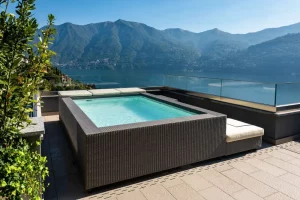
Above ground pools represent the most common category of temporary swimming pools for residential applications. These semi-permanent structures are designed for private backyards, hotel suites, and leisure facilities.
Prefabricated from fiberglass, synthetic fiber, or PVC polyester, they typically range from 12 to 24 feet in diameter with 3 to 4 feet depths. Installation takes 1 to 3 days with costs from $1,500 to $15,000. At season’s end, they can be dismantled and stored, though many remain in place year-round in temperate climates.
The advantages: cost-effective solutions without permanent concrete construction. Optional disassembly makes them ideal for seasonal use in regions with varying climates.
Portable inflatable pools
At the ultra-temporary end, portable inflatable pools offer the quickest installation—minutes to hours. These PVC or vinyl pools serve children’s play, emergency cooling, and short-term events. Sizes range from 6 to 20 feet with costs from $50 to $3,000, but they’re unsuitable for professional use or extended durability.
Professional modular panel systems
Modular panel pools represent an innovative approach gaining increasing popularity for temporary swimming pools used in sports events, educational institutions, and facilities requiring large swimming installations for specific timeframes.
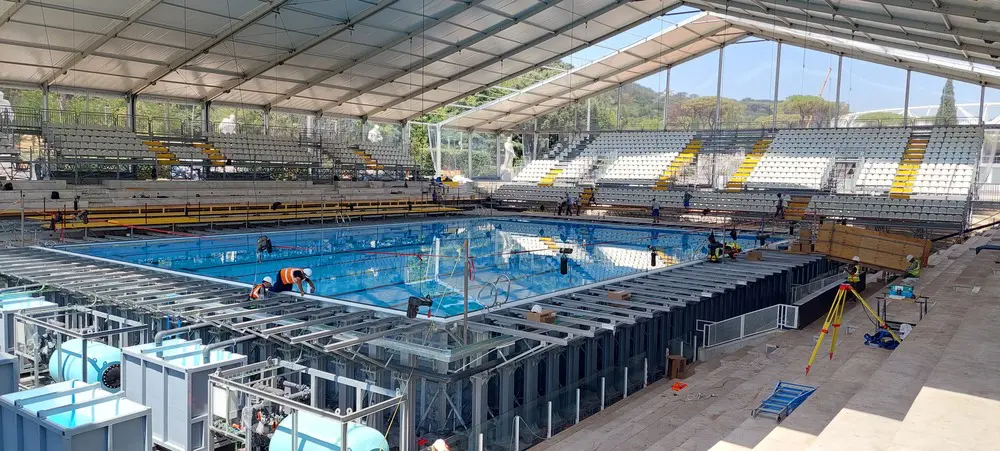
These pools are constructed using modular panels that can be swiftly assembled to create the pool basin and walls. Systems like Skypool utilize prefabricated hot-dip galvanized steel panels, which are subsequently covered with a PVC liner for waterproofing and finished with ceramic perimeter pool coping.
Once a competition or event concludes, the pool can be fully dismantled, and the facility has the space available again for other uses. This method significantly reduces installation time and costs compared to traditional in-ground concrete pools. Site preparation and excavation work are minimized, making modular panel systems an attractive option for schools, universities, sports clubs, and public institutions.
The key differentiator: modular panel systems offer the precision and durability required for professional competition while maintaining full relocatability—something neither above ground pools nor traditional concrete pools can achieve.
Comparison: temporary pool types
Type | Installation time | Cost rang | Full disassembly | Best applications |
Portable inflatable | Hours | $50–$3,000 | Yes | Children, emergency cooling |
Above ground residential | 1–3 days | $1,500–$15,000 | Possible | Backyards, seasonal leisure |
Modular panel (Skypool) | 4–8 weeks | $50,000–$500,000+ | Yes | Competitions, events, institutions |
Traditional concrete | 6–12 months | $100,000–$1M+ | No | Permanent facilities only |
What are the benefits of modular panel temporary swimming pools?
Modular panel systems offer advantages that set them apart from traditional concrete construction and consumer above ground pools.
Cost-effective installation: Prefabricated components reduce installation time and costs. Modular panels install 60-70% faster than traditional concrete pools of equivalent size, delivering substantial labor savings.
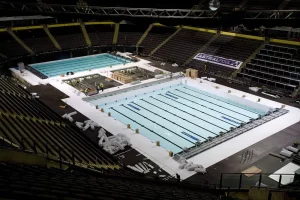
Precision and durability: Systems meet strict World Aquatics Federation tolerances for official competition. Skypool installations at the 2022 Commonwealth Games in Birmingham (50m x 15m x 2m training pool) and 2022 European Championships in Rome (31m x 21m x 3m and 17m x 17m x 6m pools) demonstrate Olympic-grade capability.
Ease of maintenance: Lightweight design allows easy panel access. Hot-dip galvanized panels resist chlorine corrosion, reducing long-term costs and ensuring 25+ year lifespan.
Seismic compliance: Engineered for seismic activity zones, meeting earthquake regulations where traditional concrete poses greater risk.
Sustainability: Modular construction generates 40-60% less excavation waste, uses 50-70% less concrete, and reduces construction water consumption by ~30%.
What are the main applications for temporary swimming pools?
Temporary swimming pools—particularly professional modular panel systems—serve diverse markets beyond residential leisure.
Competition and sporting events: World Aquatics-certified temporary pools enable hosting Olympics, Commonwealth Games, and championships in venues without permanent pools. Skypool installations have supported the 2022 Commonwealth Games and European Championships, plus unique events including X-Games at Los Angeles Staples Center, the Fundole Windsurf Indoor World Tour, and the Orangina Wake Jam Tour.
Seasonal installations: Hotels, resorts, and recreational facilities needing pools only during peak months benefit from modular systems that disassemble during off-season, freeing space for other revenue-generating activities.
Educational institutions: Schools and universities gain teaching facilities without permanent commitment. When priorities shift, modular pools relocate rather than being abandoned.
Specialized applications: Disaster response, mobile rehabilitation, and therapeutic applications where permanent infrastructure is impractical.
How are temporary swimming pools installed?
Installation processes vary dramatically between consumer above ground pools (hours to days) and professional modular panel systems (weeks). For modular panel pool construction, the process follows five key steps:
Site preparation (2–5 days): Leveling and foundation work with minimal excavation compared to traditional pools.
Panel assembly (1–2 weeks): Prefabricated galvanized steel panels are bolted together with ±2mm precision tolerances to meet World Aquatics requirements.
Waterproofing and finishing (3–5 days): PVC liner installation, ceramic coping, and competition equipment installation.
Systems integration (1 week): Filtration, heating, automation, and water treatment connection and commissioning.
Testing (2–3 days): Water filling, quality balancing, and system verification.
Total timeline for a 50m competition pool: 4 to 8 weeks—compared to 6 to 12 months for traditional concrete. Disassembly takes 1 to 2 weeks, and all components can be stored and reinstalled elsewhere.
How much does a temporary swimming pool cost?
Cost varies dramatically based on pool type, size, features, and intended use.
Consumer above ground pools: $1,500 to $15,000 for residential backyard installations. This includes the pool structure, basic filtration, and installation but typically excludes decking, landscaping, or advanced features.
Portable inflatable pools: $50 to $3,000 depending on size and quality. These represent the lowest-cost entry point but offer minimal durability and no professional applications.
Professional modular panel systems: $50,000 to $500,000+ depending on multiple factors:
- Pool size (25m recreational vs 50m competition)
- Depth requirements (2m training vs 5m diving)
- Features (movable floors, bulkheads, underwater camera systems, timing equipment)
- Compliance level (recreational vs World Aquatics certified)
Cost comparison advantage: Modular panel systems cost 30-50% less than equivalent permanent concrete pools when factoring in faster installation, minimal site work, reduced labor costs, and reusability. A modular system that costs $300,000 might replace a $500,000–$600,000 concrete pool project—while offering the added benefit of relocatability.
Return on investment for events: Temporary pools can be relocated 5 to 10+ times over their 25+ year lifespan, amortizing the initial investment across multiple installations and dramatically improving ROI compared to single-use permanent construction.
For specific project pricing, consultation with Fluidra’s engineering team is recommended, as each installation has unique site conditions, regulatory requirements, and performance specifications.
What innovations are shaping temporary swimming pools?
The temporary pool industry continues to evolve with technological and material innovations.
Smart pool management integrates IoT sensors and remote monitoring for real-time control of water quality, temperature, and chemical dosing. Connected pool technology allows facility managers to optimize operations remotely.
Digital twin technology enables operators to simulate water flow, energy consumption, and heating requirements before construction, optimizing system design from day one.
Biometric safety systems using AI-powered drowning detection provide additional safety layers, complementing traditional lifeguard supervision.
Sustainable materials like 100% recyclable galvanized steel support circular economy principles—unlike concrete pools that become landfill waste when demolished, modular panels can be reused indefinitely.
Are temporary swimming pools sustainable?
Temporary swimming pools—particularly modular panel systems—offer significant environmental advantages over traditional concrete construction.
Reduced construction impact: Modular panels generate 40-60% less excavation waste, use 50-70% less concrete, and reduce construction water consumption by approximately 30%. Factory-controlled production minimizes on-site waste.
Circular economy model: Skypool panels are designed for a 25+ year lifespan with full reuse capability. A single system can serve 5 to 10+ installations over its life. When panels reach end-of-life, the galvanized steel is 100% recyclable.
Energy and water efficiency: Precision manufacturing ensures tighter tolerances than field-poured concrete, reducing water leakage and lowering heating requirements. Modern water treatment systems reduce backwash frequency and operational water waste.
The right temporary swimming pool for every need
A temporary swimming pool needn’t be a temporary solution. From consumer above ground pools providing affordable backyard leisure to professional modular panel systems hosting Olympic-level competition, temporary pools offer versatility, cost-efficiency, and flexibility that traditional concrete construction cannot deliver.
Whether you need a seasonal installation for a resort, a relocatable training facility for an educational institution, or a World Aquatics-certified competition venue for international events, Fluidra’s Skypool technology offers unmatched precision, durability, and adaptability.
Contact Fluidra’s aquatic engineering team to discuss your specific requirements—from backyard installations to Olympic-grade competition venues. Our experts will help you select the right temporary pool solution for your application, budget, and timeline.
Frequently asked questions
What is a temporary swimming pool?
A temporary swimming pool is a non-permanent aquatic facility designed for quick installation, defined-period use, and potential relocation or storage. Types include consumer above ground pools (semi-permanent residential), portable inflatable pools (ultra-temporary), and professional modular panel systems (fully relocatable competition-grade pools). Temporary pools offer flexibility without the long-term commitment of traditional concrete installations.
Is an above ground pool the same as a temporary pool?
While above ground pools are a type of temporary pool, not all temporary pools are above ground pools. Above ground pools are typically semi-permanent residential structures designed for backyards and seasonal use. Professional temporary pools—like modular panel systems—can be fully disassembled and relocated for events, competitions, and institutional applications, offering far greater flexibility and meeting strict certifications like World Aquatics standards for Olympic-level competition.
How long does it take to install a temporary swimming pool?
Installation time varies by type. Portable inflatable pools: hours. Residential above ground pools: 1 to 3 days. Professional modular panel systems (50m competition pool): 4 to 8 weeks from site preparation to water filling—still 60-70% faster than traditional concrete pools of equivalent size, which require 6 to 12 months for construction.
Can temporary pools be used for professional competitions?
Yes. Modular panel systems like Skypool meet World Aquatics Federation standards for precision, depth, and safety, making them suitable for Olympic-level swimming, diving, water polo, and artistic swimming competitions. Skypool temporary pools have been installed for major international events including the 2022 Commonwealth Games in Birmingham and the 2022 European Aquatics Championships in Rome.
How much does a temporary swimming pool cost?
Costs range widely: consumer above ground pools ($1,500–$15,000), portable inflatables ($50–$3,000), and professional modular panel systems ($50,000–$500,000+) depending on size, depth, features, and World Aquatics certification. Modular systems cost 30-50% less than equivalent permanent concrete pools while offering reusability across multiple installations over a 25+ year lifespan.