

 -0.02 (-0.12%)
 Tornar
 The sound of moving water has something that completely changes the perception of a space. Whether we are talking about a swimming pool in a private garden, a hotel spa or a sports centre, when water comes to life through a fountain, the experience is transformed.
Modern pool water features are no longer an exclusive feature of large facilities but have become an accessible and versatile element. Beyond aesthetics, they improve water circulation, promote oxygenation, and can provide hydrotherapy benefits. Below, we analyse the types available, the most suitable materials, how to choose the ideal option, and what technical aspects to consider.
Submergeix-te més amb l’eBook


 Contacte
 Tancar
What are modern pool water features and what do they do?
Pool water features (or pool fountains) are devices that propel or project water in a controlled manner (jets, sheets, curtains or waterfalls) for aesthetic, functional or therapeutic purposes. They are installed in both residential pools and commercial environments such as hotels, spas, and sports centres.
Although often associated solely with decoration, modern pool water features serve a dual purpose. The visual and auditory effect of moving water enhances the perception of quality in the space. At the same time, the movement promotes water circulation in the pool, helps distribute treatment products and improves surface oxygenation.
Terms such as waterfall, geyser and fountain are often used interchangeably, but they refer to different types with their own characteristics and installations.
What types of pool water features are there?
Modern pool water features are classified according to how they project the water, where they are installed and what experience they create. The main categories are waterfalls, laminar fountains, geysers, swan necks, floating fountains and hydrotherapy jets.
Wall waterfalls and water curtains
These project a uniform sheet of water that falls from an edge or wall. Within this category, the most notable are sheer descent waterfalls (crystalline and silent), those embedded in decorative walls, and versions with integrated LED lighting. They are especially popular in rectangular pools and hotel projects.
Laminar fountains
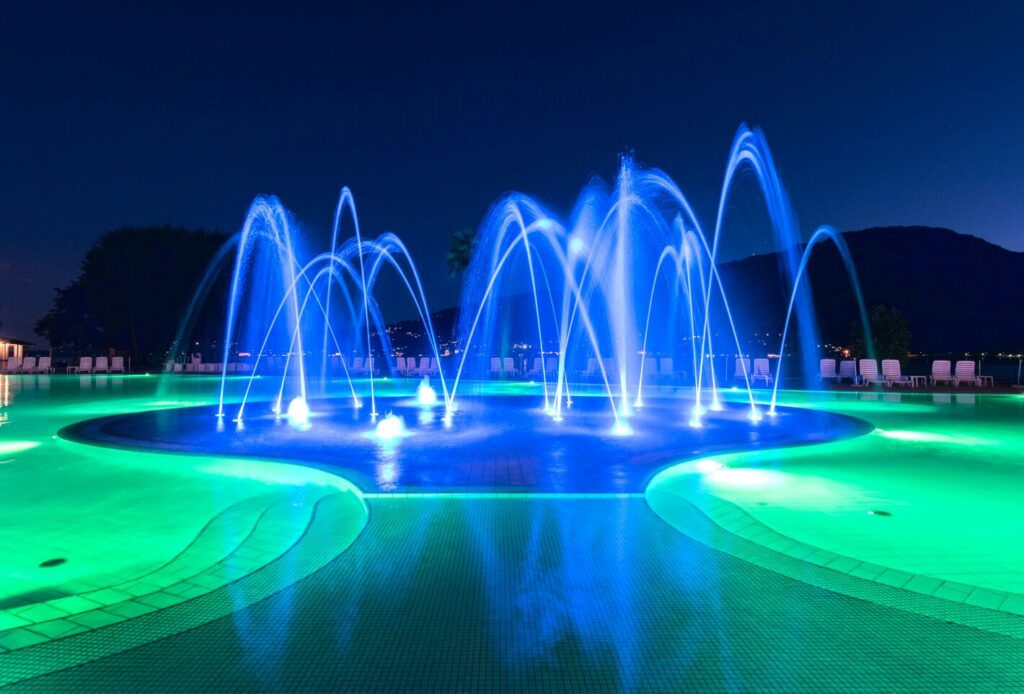
These produce transparent, curved jets that create liquid crystal arcs. Combined with RGB LEDs, the light travels through the water, creating a spectacular effect. They are common in premium design pools and high-end hotels, where the visual impact is also highly shareable on social media.
Geysers and bubblers
Vertical jets that emerge from the ground or shallow areas (entrance beaches, splash pads). They are playful and interactive: ideal for family pools, resort hotels, water parks and leisure centres.
Goosenecks and cannons
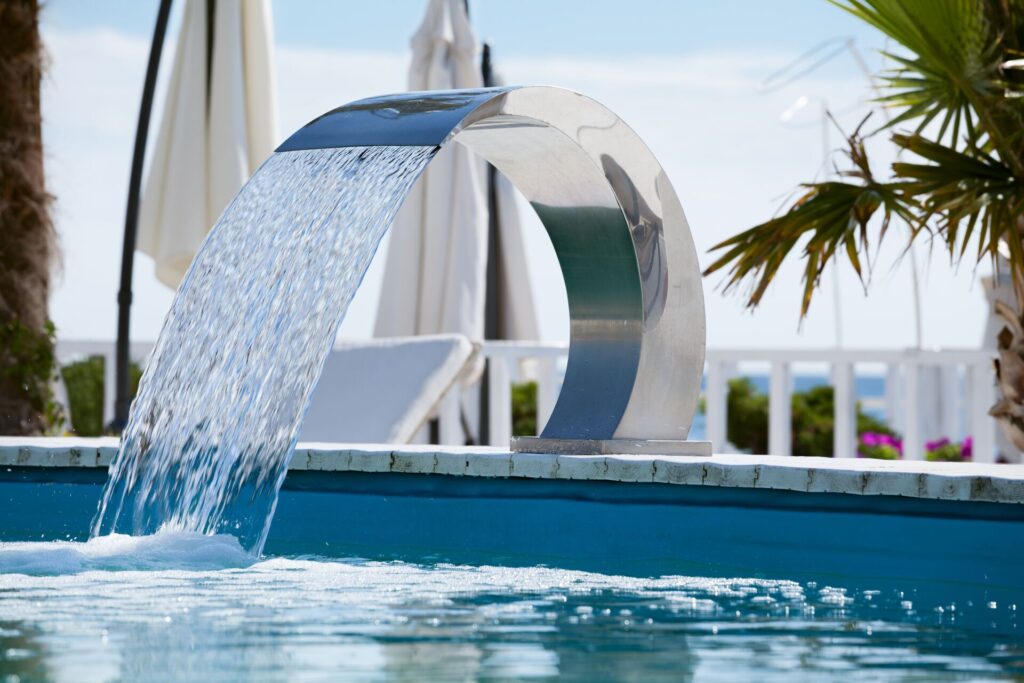
Curved stainless steel elements that project a parabolic jet. In addition to their aesthetic value, they offer a therapeutic component: the pressurised jet provides cervical, dorsal and lumbar massage. Widely used in spas, wellness circuits and sports clubs.
Floating fountains
Autonomous devices that are placed on the surface and project water upwards. Their great advantage: they do not require any construction work. There are solar, LED and anchored versions. A practical alternative for adding an aquatic element to existing pools.
Hydrotherapy jets and nozzles
Built-in nozzles that project jets of water, air or both. Directly linked to the wellness experience and balneotherapy: they work on specific areas of the body and allow you to configure hydromassage programmes. Common in spas, hot tubs and thermal circuits.
What materials are most suitable for modern pool water features?
AISI 316 stainless steel is the material of choice due to its high resistance to corrosion in chlorine and salt environments. However, the choice depends on the type of water treatment, location and budget.
AISI 304 works well in pools with conventional chlorine, but falls short in salt chlorination installations, where AISI 316 is essential. Acrylic is lightweight and transparent, ideal for waterfalls with LEDs. UV-resistant engineering plastics (ABS) are economical options suitable for floating fountains. Natural or artificial stone fits in with rustic-style waterfalls, although it requires waterproofing. And fibreglass offers good value for money for pre-designed decorative waterfalls.
It is important to consider water treatment, exposure to the elements, expected durability and budget together. The wrong choice can lead to premature corrosion or limescale deposits that compromise your investment.
How to choose the right pool water feature for your pool?
The choice depends on three variables: the purpose (aesthetic, therapeutic or recreational), the characteristics of the pool (size, shape, location) and the user profile.
In a residential pool, wall waterfalls, floating fountains and small swan necks prioritise aesthetics and low maintenance. In a hotel, laminar fountains and waterfalls with LEDs provide the visual impact needed to stand out. Sports centres opt for swan necks and hydrotherapy jets, where therapeutic function is paramount. In spas and wellness circuits, built-in jets and sensory showers seek to provide a precise wellness experience. And in water parks, geysers and splash pads prioritise interaction and safety.
The key is to integrate the pool water feature as part of the overall pool design, rather than as an afterthought. When considered from the design stage, hydraulics, aesthetics and performance are optimised.
What functional benefits do pool water features offer beyond aesthetics?
Modern pool water features actively contribute to water circulation, oxygenation, chemical distribution and the physical well-being of users.
From a hydraulic point of view, the movement generated by a fountain helps to avoid dead zones and complements the work of impellers and skimmers, contributing to a more homogeneous water quality. When the jet breaks the surface, gas exchange is promoted, which can reduce algae formation, an effect that is particularly useful in outdoor pools and warm climates.
In therapeutic terms, pressurised jets offer massage and hydrotherapy that relieves tension and improves blood circulation. And on a sensory level, the sound of moving water reduces stress and improves the perception of comfort: a factor that in commercial facilities translates directly into a better experience and a greater likelihood of return.
How is a fountain installed in a swimming pool?
Installation depends on the type: built-in fountains are integrated during construction, while floating fountains or those connected to the filtration circuit can be added to existing pools with minimal intervention.
Integrated pool water features (built-in waterfalls, jets, floor geysers) require prior planning: defining the location, built-in pipes, necessary flow rate and pipe diameter from the design phase. For existing pools, it is possible to connect the fountain to the filtration return line with a regulating valve or install a dedicated independent pump.
In any case, it is important to consider the hydraulics: flow rate according to the type of fountain, pump power, pressure drop and location of the technical room. In commercial projects, it is essential to have a specialist professional to determine the dimensions.
What role do lighting, and automation play in modern pool water features?
LED lighting and automation transform fountains into dynamic elements: programmable, remotely controllable and capable of creating different atmospheres depending on the time of day.
RGB LED lighting multiplies the aesthetic potential of any pool water feature. In waterfalls, it creates a luminous curtain effect; in laminar fountains, the light travels through the interior of the water arch; in geysers, it adds an additional playful component. All this with low energy consumption. Automation systems allow you to programme schedules, create scenes and connect fountains to intelligent pool management platforms, an approach that connects with the concept of the pool as an integrated ecosystem.
In commercial projects, this combination opens specific possibilities: differentiated night-time environments, sunset sessions, water and light shows, or simply ensuring that the water features only operate when the pool is in use.
What maintenance considerations do modern pool water features require?
Well-designed pool water features require minimal maintenance, focusing on periodic cleaning, nozzle inspection, and corrosion protection.
The most frequent point of attention is limescale deposits on nozzles and metal surfaces, especially in areas with high water hardness. Regular cleaning and proper chemical balance management (starting with pH) help prevent this. It is also advisable to periodically check the pump and flow rate: a drop in pressure may indicate blockage or wear.
The choice of material during the design phase has a direct impact on long-term maintenance: AISI 316 stainless steel in salt chlorination systems prevents corrosion problems. In outdoor pools, winterisation (protecting pipes and pumps during cold months) extends the useful life of the equipment.
Pool water features as a key element in transforming the aquatic experience
Modern pool water features are no longer merely a decorative accessory but have become a strategic component of aquatic design. They add aesthetic, functional and experiential value, and their impact is multiplied when they are chosen and integrated correctly from the design phase onwards.
The key lies in making informed decisions about type, material, hydraulic installation and lighting. Decisions that, with a comprehensive vision, allow both the user experience and the efficiency of the installation to be maximised.
In this context, having a specialised partner makes all the difference. Fluidra and its brands, including AstralPool, provide the tools and knowledge necessary to integrate modern pool water features into residential and commercial projects with guarantees of quality, durability and performance.
Frequently asked questions about modern pool water features
Can a fountain be installed in an existing pool?
Yes. Floating fountains do not require any construction work. It is also possible to connect a fountain to the filtration return line (with a regulating valve) or install a separate pump. For built-in pool water features, the intervention is greater.
How much does it cost to install a fountain in a pool?
The cost varies depending on the type and complexity. A floating fountain can cost less than £100, while an AISI 316 stainless steel waterfall with LED lighting can cost over £1,000. In commercial projects, it depends on the design, flow rate and hydraulic integration.
What is the difference between a waterfall and a pool fountain?
A waterfall projects a sheet of water that falls by gravity from an edge or wall. A fountain propels water in any direction. The term “pool fountains” encompasses waterfalls, geysers, laminar fountains, jets and other water features.
Do modern pool water features use a lot of electricity?
It depends on the type. Floating solar fountains have no energy cost. Those connected to the filtration circuit use the existing pump. Those with a separate pump consume energy according to their power, but variable speed pumps and time programming allow consumption to be optimised.
What type of pool water feature is best for a hotel or spa?
For hotels, sheer descent waterfalls with LEDs and laminar fountains create a high visual impact with low maintenance. For spas, swan necks, hydrotherapy jets and sensory showers add therapeutic value and enhance the guest experience.